


Welcome to Solvitur Ambulando, which means "Solve It By Walking." On this journey, we explore the alchemic potency of walking for sorting through life's puzzles, exploring our world, and transforming ourselves. Like a good walk, you will encounter distinctive ideas, remarkable people and gorgeous scenery. I hope you will take a beautiful walk today. And if you like what you read and hear, please
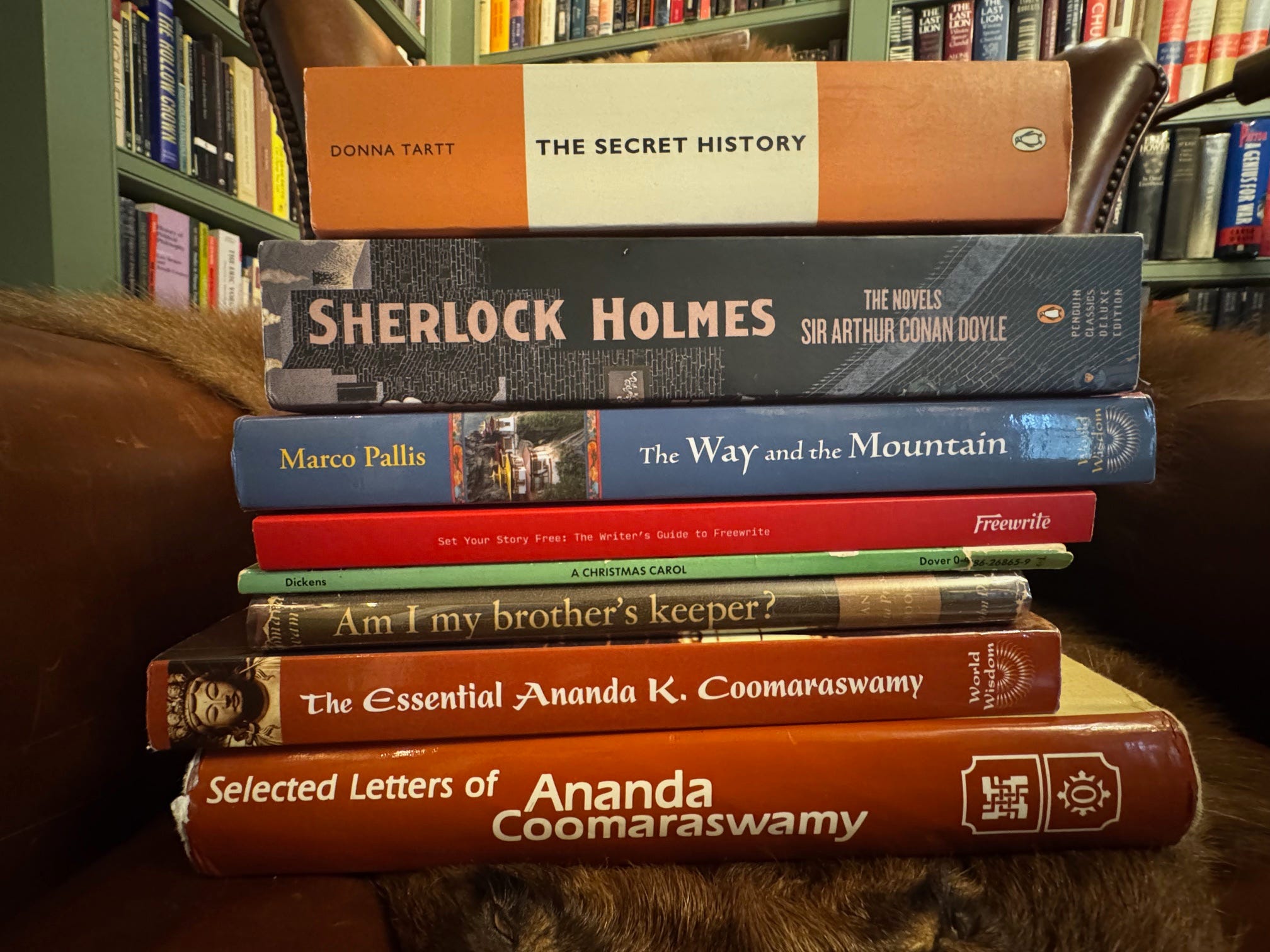
Happy New Year! 2025 turned out to be a wonderful year of reading for me — I delved into Traditionalism, re-learned what a joy and fun great literature can be, renewed my deep affection for that greatest of fictional (?) detectives, and continued my readings in mythology from around the world. Also for the first time since college, I read several books in community. I wondered how much I would enjoy reading in a book club and in other communities. It turned out: I loved it! What a fantastic expansion of my reading experience in 2025!
Below you can see my reviews of the books I read in the fourth quarter — and links to Q1, Q2 and Q3 are below them.
May this New Year — 2026 — bring you joy, friendship and fulfillment. And of course I hope you enjoy a beautiful walk today, and every day. Onward! A Joyful New Year to all the world!
Frankenstein by Mary Shelley
“But it is a still greater evil to me that I am self-educated”
“He is so gentle, yet so wise”
“My temper was sometimes violent, and my passions vehement; but by some law in my temperature they were turned not toward childish pursuits but to an eager desire to learn....It was the secrets of heaven and earth that I desired to learn.”
“I will pioneer a new way, explore unknown powers, and unfold to the world the deepest mysteries of creation.”
Published in 1818, over two centuries ago, the Gents Books Club read this novel in October, but alas, I could not attend the meeting. I felt the loss keenly as I found this book attractive and repulsive.
My dominant takeaway: Even 200 years ago, people could grasp the potential terrors incumbent on a society which had abandoned even the pretense of initiation for men. Beware the merely self-educated. Beware the man of genius without a guru, guidance, limits. Beware the uninitiated man.
Dracula by Bram Stoker
“When we started, the crowd round the inn door, which had by this time swelled to a considerable size, all made the sign of the cross and pointed two fingers towards me. With some difficulty I got a fellow-passenger to tell me what they meant; he would not answer at first, but on learning that I was English he explained that it was a charm or guard against the evil eye.”
I read Dracula this year along with the Substack, Dracula Daily. I’m glad I did so — it demonstrated the actual lapsing of time in the story and offered a new way for me to experience the novel. But overall I liked the Daily Dracula far less than reading the novel. Reading the novel assures a certain tension, a particular drama of events that I found lacking when stretched to the actual 6 months. Still, if you have never read Dracula, ah, ah, ah, my friend....you simply do not know what you are missing. So light a fire, rest your feet on an Ottoman, and take heed of the supernatural in our all-too-fragile natural world.
The Secret History by Donna Tartt
““It’s a terrible thing, what we did,” said Francis abruptly. “I mean, this man was not Voltaire we killed. But still. It’s a shame. I feel bad about it.”
““Well, of course, I do too,” said Henry matter-of-factly. “But not bad enough to want to go to jail for it.””
Another book read by our Gents Books Club. In the 30-plus years since its publication, it has garnered an enormous cult following — podcasts dedicated to it, online groups, Reddit subs and much more. As one of our bookclub friends noted, it so clearly portrays a thin moment in time in a very specific setting. And the book does so with wonderful success. For me, the book provides a meditation on the young, especially young men, living in a society which has forgotten how to initiate them, or why such initiation played a crucial societal role for thousands of generations. And ultimately the book raises difficult questions about the advisability of smart, talented young men walking around in that uninitiated state. And the supreme danger of young men attempting to initiate themselves. Any thoughtful observer knew Napoleon’s days were numbers once he crowned himself Emperor. Even Jesus let Himself be baptized by another. We cannot initiate ourselves into the mysteries of this universe.
Am I My Brother’s Keeper? by Ananda K. Coomaraswamy
“What better homage to his [Coomaraswamy’s] memory can one find than to join him in striking a blow or two in the battle of Kurukshetra, which is ever with us? No need to look far afield for opportunities; one’s daily occupations, one’s home with its furnishings, how one spends one’s leisure time, what one chooses to wear or not to wear and for what reason, all these things together contribute a field of battle adequate to the powers of any normal person” – Marco Pallis, in his Prologue to The Essential Ananda K. Coomaraswamy
“As for Hinduism and Buddhism, Plato and St Thomas Aquinas, you see differences where I see essentially sameness.”
“In any case, let me say, speaking for Hindus as to Christians, that even if you are not with us, we are with you.”
These three books offer excellent introductions to Coomaraswamy’s views on the Perennial Philosophy. Looking back, I should have read them before his book Hinduism and Buddhism, and now I will go back and re-read that book. Comaraswamy is a tough, cogent, hard-hitting writer, unyielding in his hard questioning of philosophers, religious figures and writers who dare to write of the great traditions of the East without having read and studied their magnificent Scriptures in their original languages. In that sense, his writings become a beacon of humility — a suggestion that we come to evaluate more honestly that which we do not know. And in doing so, we prostrate ourselves in fitting humility before the Divine Mystery of the Universe. Coomaraswamy has thus already become one of the great teachers of my life.
The Way and the Mountain by Marco Pallis
“[O]ne of the commonest obstacles in the way of spiritual development is the existence, in greater or lesser measure, of a contradiction between the outward and inward life of the being.”
As with Coomaraswamy, 2025 represents my introduction to Marco Pallis. His Peaks and Lamas might be my book of the year. I loved this book of his essays as well. Pallis traveled to Tibet in the 1930s and 1940s, and eventually became initiated into Tibetan Buddhism, taking the name Thubden Tendzin. Like Coomaraswamy, he viewed the essential rightness of the Perennial Philosophy, or, as he called it, Tradition. He found himself especially drawn to the Tibetan Buddhist manifestation of that Tradition — or did it call to him? — and he spent the greater part of his life bringing a more profound appreciation of that Tradition to the West.
Set Your Story Free: The Writer's Guide to Freewrite edited by Annie Cosby with Colin Butts
“Just let the thoughts flow.”
Since I began using Freewrite devices, I’d wanted to read their manifesto, as it were. Good overview of “freewriting” and why it offers a useful approach for writers. As I’ve written elsewhere, nothing has affected my writing process as much as Freewrite this year. An excellent, and needed, addition to my process.
A Christmas Carol by Charles Dickens
““It’s Christmas Day!” said Scrooge to himself. “I haven’t missed it. The Spirits have done it all in one night. They can do anything they like. Of course they can. Of course they can.””
My full review of my 30th annual reading of this lovely story is here. My old political philosophy professor, Fr. James Schall, S.J., used to say that if you’ve only read a book once, you really haven’t read it. My 30th reading of this book made me wonder whether he meant to say, “If you’ve only read a book 29 times, you really haven’t read it.”
A Study in Scarlet by Sir Arthur Conan Doyle
“Like all other arts, the Science of Deduction and Analysis is one which can only be acquired by long and patient study, nor is life long enough to allow any mortal to attain the highest possible perfection in it.”
For Christmas, I received the Lego Sherlock Holmes book nook set. I delighted enormously in building it and now it happily resides in my library next to my Holmes collection of books. Even though I’d read The Penguin Complete Sherlock Holmes early this year, the build inspired me to re-read this first Holmes novel. Ah, I delighted in reading the words of “John H. Watson MD, late of the Army Medical Department,” as he introduces us to this curious character, this “consulting detective,” who has so palpably affected our imaginations for well over a century.


(This article contains Amazon Affiliate links. As an Amazon Associate, I earn from qualifying purchases.)
Love reading your reflections - wishing you a wonderful 2026!
OMG - the Legos!!! Fantastic! Good reads this quarter!