


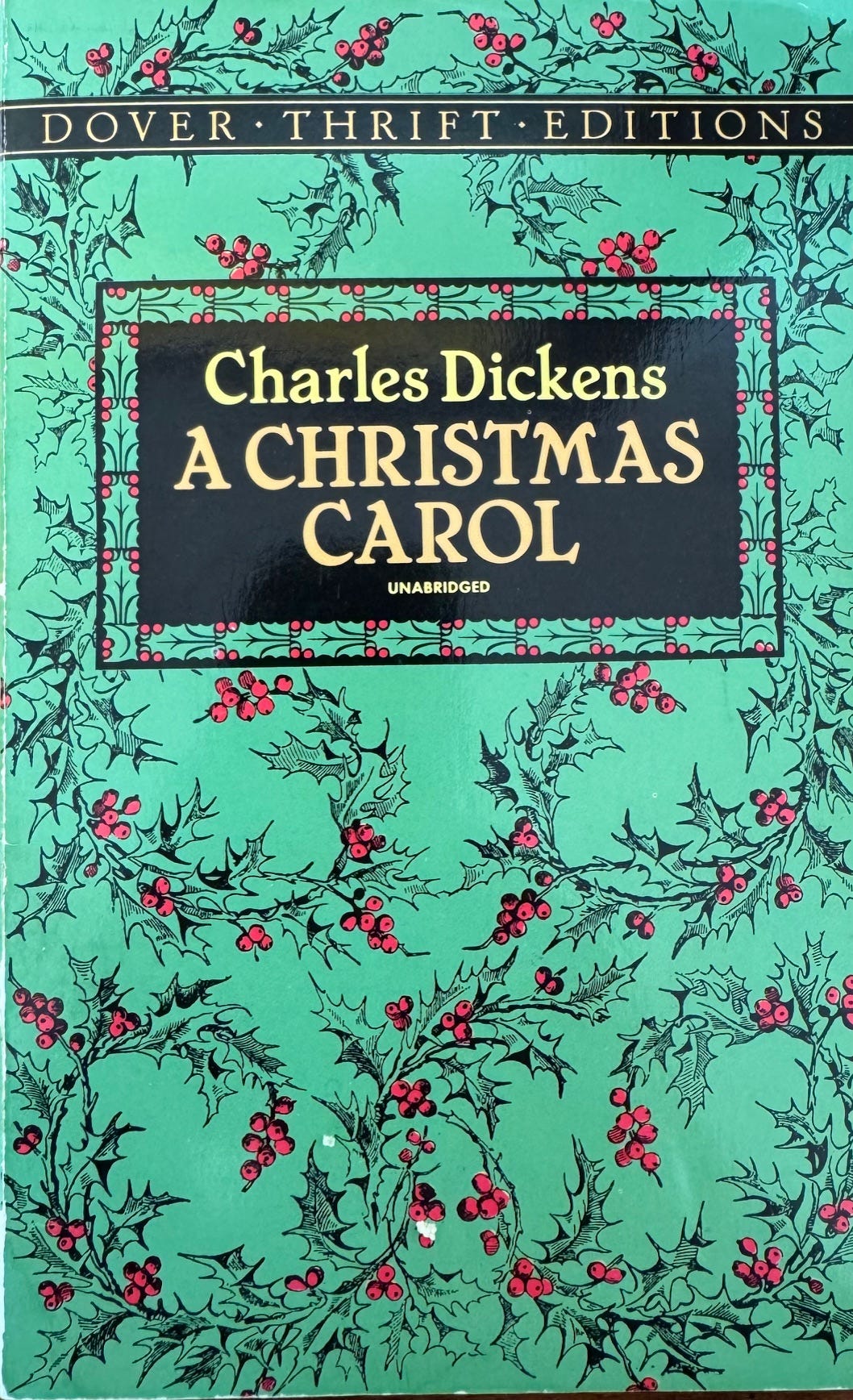
You read a book 29 times and you know it, right? I mean, you hear a song 29 times, and you’ve memorized it — every word, every chord, every beat. Right?
As I read A Christmas Carol this year — my 30th annual reading between Thanksgiving and Christmas Eve — it increasingly dawned on me that I had missed a fundamental part of the story. Sure, I read it and I knew it. But I didn’t truly internalize it or appreciate its significance.
What had escaped me for nearly three decades?
Scrooge transformed in one night.
““What’s today, my fine fellow?” said Scrooge.
““To-day!” replied the boy. “Why, CHRISTMAS DAY.”
““It’s Christmas Day!” said Scrooge to himself. “I haven’t missed it. The Spirits have done it all in one night. They can do anything they like. Of course they can. Of course they can.””
In fact, from the first scene to which the Ghost of Christmas Past transports Scrooge, we can tell some magical alteration is afoot. He instantly becomes giddy at the sight of his old school:
““Good Heaven!,” said Scrooge, “I was bred in this place. I was a boy here!”
““Your lip is trembling,” said the Ghost, “And what is that upon your cheek?”
“Scrooge muttered, with an unusual catching in his voice, that it was a pimple; and begged the Ghost to lead him where he would.
““You recollect the way?” inquired the Spirit.
““Remember it!” cried Scrooge with fervour — “I could walk it blindfold.””
He behaves so differently, so contrary to how we view him at the beginning of the book, that he already appears as an altered man. The rest of his experiences with the Three Spirits complete this rehabilitation. The book ends with Scrooge waking up on Christmas Day as a totally new man:
“He became as a good a friend, as good a master, and as good a man, as the good old city knew”
The message I took from this year’s reading — change, improvement, reform, redemption — can happen quickly. In a day, a night, a weekend.
And not only in one aspect of life. Many of them, or even all of them. Scrooge had become submerged in many sins — greed, avarice, unfeelingness toward his fellows, profound remoteness (“secret, and self-contained, and solitary as an oyster”), single-minded focus on himself and his money, and venomous miserliness. The Three Spirits did not chisel away at one of these sins during the night. They thrashed all of them. All at once. So that when he rose on Christmas Day, his old self lay in ruins — completely, to the core. His new self had emerged, a sun to brighten the remainder of his days. It reminds me of G.K. Chesterton’s description of the arrival of St. Francis of Assisi, a symbol of the end of the Dark Ages:
“While it was yet twilight a figure appeared silently and suddenly on a little hill above the city, dark against the fading darkness. For it was the end of a long and stern night, a night of vigil, not unvisited by stars. He stood with his hands lifted, as in so many statues and pictures, and about him was a burst of birds singing; and behind him was the break of day.”
Scrooge still engaged in business — his profits allowed him to assist the Cratchits and Tiny Tim. He still made money — enabling him to donate to the less fortunate. But all these aspects of life had gained a new perspective. He had attained perspective and understanding. He was reborn as a new Scrooge on that Christmas Day.
To be clear, we witness two changes by Scrooge: his “reclamation” from curmudgeonly scoundrel to noble friend, employer and citizen; and also — earlier in the novel, through his experiences with the Ghosts of Christmas Past and Present — his devolution from seemingly normal young English lad to “a squeezing, wrenching, grasping, scraping, clutching, covetous old sinner!”
While his magnificent reform transpires in one night, his devolution from regular schoolboy into the unfeeling Ebenezer Scrooge takes time. We do not see it in the visions of Scrooge as a schoolboy, or even as an apprentice with Fezziwig. We only see his degradation in the exchange with his then-fiancee Belle.
“For again Scrooge saw himself. He was older now; a man in the prime of life. His face had not the harsh and rigid lines of later years; but it had begun to wear the signs of care and avarice. There was an eager, greedy, restless motion in the eye, which showed the passion that had taken root, and where the shadow of the growing tree would fall.
“He was not alone, but sat by the side of a fair young girl in a mourning dress: in whose eyes there were tears, which sparkled in the light that shone out of the Ghost of Christmas Past.
“”It matters little,” she said softly. “To you, very little. Another idol has displaced me; and, if it can cheer and comfort you in time to come as I would have tried to do, I have no just cause to grieve.”
“”What Idol has displaced you?” he rejoined.
““A golden one.”
“”This is the even-handed dealing of the world!” he said. “There is nothing on which it is so hard as poverty; and there is nothing it professes to condemn with such severity as the pursuit of wealth!”
“”You fear the world too much,” she answered gently. “All your other hopes have merged into the hope of being beyond the chance of its sordid reproach. I have seen your nobler aspirations fall off one by one, until the master passion, Gain, engrosses you. Have I not?”
“”What then?” he retorted. “Even if I have grown so much wiser, what then? I am not changed towards you.”
“She shook her head.
“”Am I?”
“”Our contract is an old one. It was made when we were both poor, and content to be so, until, in good season, we could improve our worldly fortune by our patient industry. You are changed. When it was made you were another man.”
“”I was a boy,” he said impatiently.
“”Your own feeling tells you that you were not what you are,” she returned. “I am. That which promised happiness when we were one in heart is fraught with misery now that we are two. How often and how keenly I have thought of this I will not say. It is enough that I have thought of it, and can release you.”
“”Have I ever sought release?”
“”In words. No. Never.”
“”In what, then?”
“”In a changed nature; in an altered spirit; in another atmosphere of life; another Hope as its great end. In everything that made my love of any worth or value in your sight. If this had never been between us,” said the girl, looking mildly, but with steadiness, upon him; “tell me, would you seek me out and try to win me now? Ah, no!”
“He seemed to yield to the justice of this supposition in spite of himself. But he said, with a struggle, “You think not.”
“”I would gladly think otherwise if I could,” she answered. “Heaven knows! When I have learned a Truth like this, I know how strong and irresistible it must be. But if you were free to-day, to-morrow, yesterday, can even I believe that you would choose a dowerless girl – you who, in your very confidence with her, weigh everything by Gain: or, choosing her, if for a moment you were false enough to your one guiding principle to do so, do I not know that your repentance and regret would surely follow? I do; and I release you. With a full heart, for the love of him you once were.”
“He was about to speak; but, with her head turned from him, she resumed:
“”You may – the memory of what is past half makes me hope you will — have pain in this. A very, very brief time, and you will dismiss the recollection of it gladly, as an unprofitable dream, from which it happened well that you awoke. May you be happy in the life you have chosen!”
“She left him, and they parted.”
Presumably this devolution takes time — years, or at least many months. Belle knows herself and what she’s about. She seems unlikely to have begun dating Scrooge, or become engaged to him, if she’d perceived that Gain would take over his life in the way it ultimately did. And so his decline occurs during the time of their courtship – at least from what we witness going ourselves alongside the Ghost of Christmas Past. So he declines over a year, or maybe two or three. He declines further, steeply, after Belle exits his life.
Scrooge does not perceive his change as a deterioration. He views it as more exactly appreciating the ways of the world, and what the world needs or demands. Belle — and the Ghost of Christmas Past, and we, and Scrooge alongside the Ghost of Christmas Past — clearly view it as a steep moral descent.
How, I wonder, am I different today than I was yesterday? To me, I seem the same. I perceive no difference. But what does my wife, for example, see that I do not? What do my daughters see that I do not? Or my friends? Am I really the same man today as I was yesterday? Or the day before? Or the year before? Or a decade before? I do wonder, what would they say?
I might want to ask those questions. As a dear friend once said, objective self-criticism is very hard.
Dickens suggests moral decline takes time. But again, all these years I’d missed his view of reform, or improvement.
I, for one, have this view that self-improvement takes time. Months, years, even decades — chipping away at flaws, sanding out the rough edges, tackling one area then another, and then the next.
Again, my key insight was that Scrooge reformed in one night. Nearly instantly. So perhaps Dickens has something to tell me about how I should go about my own betterment.
Don’t take my time. Do it all at once. Now.
Because, like Jacob Marley, maybe there are no Ghosts coming for me.
If you’ve never read A Christmas Carol, you will love it! You can read it in an evening. If you have read it before, consider reading it again this holiday season. You may look at it — and the world, and yourself — differently this time. Merry Christmas! Happy Holidays to all the world! A Very Happy New Year, and “as Tiny Tim observed, God Bless Us, Every One!”
I start my second annual read on Monday! 💙 Thanks for inspiring this new tradition for me, and for your beautiful meditation on the power of redemption. Merry Christmas to you and your loved ones, Russell!
This is Charles Dickens' watered down version. The original which he plagiarized was far more powerful. I found a great deal of evidence hiding underneath his redactions, when I transcribed his entire manuscript (which is made available online by the Morgan Library and Museum). Mynew book, presenting that evidence, is entitled "The Sacred Carol: Rediscovering the True Authorship of a Christmas Classic."