


Welcome to Solvitur Ambulando, which means “Solve It By Walking.” On this journey, we explore the alchemic potency of walking for sorting through life’s puzzles, exploring our world, and transforming ourselves. Like a good walk, you will encounter distinctive ideas, remarkable people and gorgeous scenery. I hope you will take a beautiful walk today. And if you like what you read and hear, please
Do you need a day of peace and reflection? Do you need to slow down for even a few hours? Are you aching for the restorative beauty of nature? Consider a personal retreat at Holy Hills Hermitage. Only 90 minutes from Louisville, the splendid spring season makes for the perfect time for a visit. You can read my full piece on the Hermitage here. Or, to inquire about a retreat for an individual or small group, you can reach out to the Hermitage Manager.

At the start of 2026, I did something I’d never done before. I wrote out a list of books I hoped to read during the year — an “aspirational” reading list. I don’t feel wedded to the list — if I want to deviate from it, or abandon it altogether, so be it. It’s my reading time, after all, my reading life. But I enjoyed the exercise and it did focus me. After all, I consistently read about 50 books per year. So if I live another 20 years, I can finish reading about 1,000 more books. That may seem like a lot, but I assure you, gentle reader, it falls far, far below my aspirations. So some focus and tethering to long-term desire may prove useful.
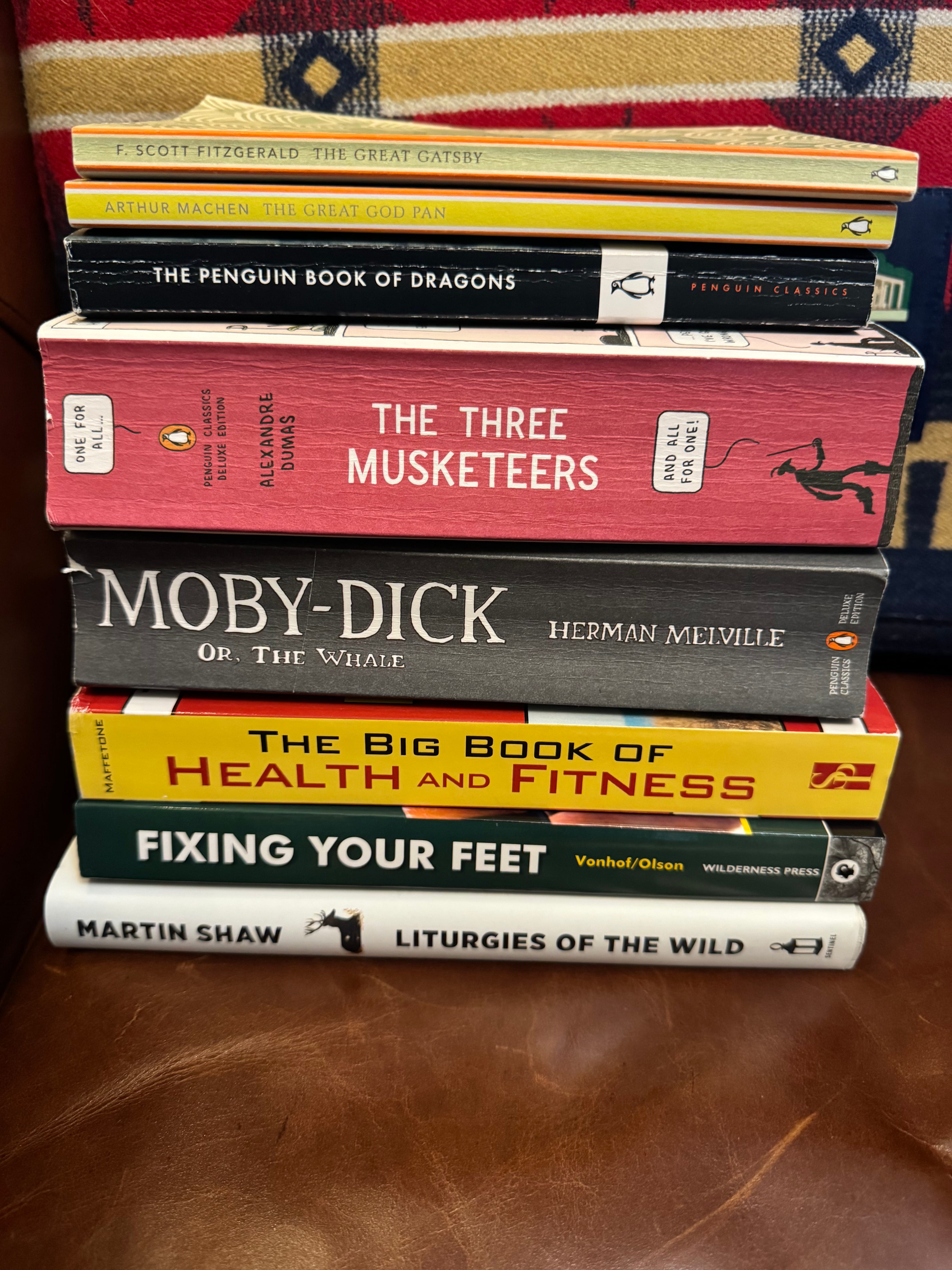
From my “2026 Aspirational Reading List,” I tackled a few books this quarter: Moby Dick, Jane Eyre, an Eknath Easwaran translation, and Martin Shaw’s new book. And I re-read one of my very favorite books, Hermann Hesse’s The Journey to the East, to prepare for the book conversation on April 16th. I loved it as much in this reading as I ever have before. Marvelous!
All in all, a wonderful quarter of reading! On to Q2!

The Dhammapada translated by Eknath Easwaran (audiobook)
“The wise are disciplined in body, speech and mind. They are well controlled indeed.”
A wonderful way to open the New Year! I can’t attest to the literal accuracy of Easwaran’s translation of this account of the Buddha’s teachings. But as an audiobook, the passages sing in loving and beautiful language. I wish I’d read – or listened to – it years ago.
Jane Eyre by Charlotte Brontë
“The spoons were moved slowly: I saw each girl taste her food and try to swallow it; but in most cases the effort was soon relinquished. Breakfast was over, and none had breakfasted. Thanks having been returned for what we had not got, and a second hymn chanted, the refectory was evacuated to the schoolroom.”
Now that – that is directness and sarcasm I appreciate. I must admit: I figured to pass through this life never having to read any books by the Sisters Bronte, often recalling William Manchester’s relating of Winston Churchill’s quip upon the defeat of a venerable Member of Parliament: “Thank God we’ve seen the last of that Wuthering Height.”1
On the first day or two of the New Year, my dear friend Charles texted a couple friends, calling Jane Eyre “the Greatest Book Ever.” High praise indeed from a reader of quantity and quality. So, I broke my recurring “vow” to order no new books in the New Year and to order “nothing – not ONE ITEM” from Amazon in the New Year (as I solemnly pledged to my family), and shortly Miss Eyre arrived in a brown, or blue and white, envelope on my doorstep. I began the book that evening and didn’t regret it for a minute. I worried her 1800s language and expressions would bore me or prove difficult to decipher; neither worry came to reality. Bronte does not write with the visual expressiveness of, say, Charles Dickens, but she writes forcefully, directly and again, with a sarcasm I admire. Jane knows who she is and what she’s about, which makes the final 150 pages so fraught – I stayed up until 1:00am to find out and finish the novel. Will she cave to the admonitions of St John Rivers? Will she go that last extremity to seek, and find, as if for the first time, her true love? Will she live as she speaks, that “domestic endearments and household joys” and “the best things the world has”? Or will her slender, wispy self crumble under the weight of a world which scorns her when it cannot use or abuse her?
Football by Chuck Klosterman
“Pervasive institutional control, so entrenched that it’s become unremarkable, is both the facilitator for society’s overall enhancement and the reason so many individuals within that society feel alienated by the very things that make life easier. Everything was upgraded and nothing got better....Football is a chaotic replication of bureaucratic life.”
“What is already happening, and what will continue to happen, is that the evolution of American culture is in direct opposition to the culture of American football. The sport, in almost every way, is a contradiction of what enlightened people are supposed to want. It conflicts with how modern people are socialized to think, subverting the symbolic meaning of what football represents.”
“Canada did its best, but Canada fucked up. And now the Canadians just have to live with it.”
“I mean, it’s like the hokey pokey. Put your right foot in, you take your right foot out, you put your right foot in, you shake it all about. You do the hokey pokey and turn yourself around. Boom! That’s what it’s all about.” –“John Madden” talking with David Letterman, not quoted in Klosterman’s book.
“When you see butt sweat like that, you know that guy is giving his all.” – John Madden, also not quoted in Klosterman’s book.
“This is a football.” – Reportedly said by Dan Dierdorf. Or John Madden. Or in spoofs of them. Also not quoted in Klosterman’s book.
You can read my full review here.
The Black Count by Tom Reiss (audiobook)
“Napoleon could not stand the sight of a black man who was taller, stronger, braver, and more beloved by his troops than he was.”
The father of Alexandre Dumas the author inspired many of the scenes from the writer’s novels, especially in The Count of Monte Cristo. The father overcame benign neglect (at best) from his ne’er-do-well father, racism, and many other challenges to rise very high in the Revolutionary army.
Before this book, I held a low view of Napoleon. This book knocked that view down a few further rungs. What a piece of garbage.
The Three Musketeers by Alexandre Dumas
“D’Artagnan obeyed, for Athos had the solemn voice and the powerful gesture of a judge sent by the Lord himself. And so, after D’Artagnan, Porthos came in, followed by Aramis, Lord de Winter, and the man in the red cloak.”
It doesn’t carry the ethical and intellectual weight of The Count of Monte Cristo. But it sure makes for a wild ride through Paris, the French countryside and England. And who among us does not wish for friends, only a few, dear friends, about whom we could say, “all for one and one for all” and who would say the same about us?
Moby Dick by Herman Melville
“Towards thee I roll, thou all-destroying but unconquering whale; to the last I grapple with thee; from hell’s heart I stab at thee; for hate’s sake I spit my last breath at thee.”
The first 200 pages flew by, then the book slowed and my interest waned. I returned again and again, for 10 pages here, 20 pages there, and so on. Finally, achingly, I rushed through the final 100 pages to finish. I made it, but almost assuredly I shall never pick up the book again.
The mad, swirling pursuit of vengeance - I tired of it. Yes, that deep, gut-burning, wrecked emotion makes for great plots and literature - Moby Dick, the Count of Monte Cristo, among many others. But in a world in which we seem to crave vengeance on thousand year old wrongs, and hours old mistakes, I have grown tired of vengeance. Weepy and exhausted, even if the reading - not even the living.
It may not make for a classic plot, but I would love to read the book in which Christ’s admonition to forgive seven times 77 times is given air and feeling and life.
This leads to a further thought. If I had been a smart, even clever, Englishman of the 1850s, if I’d read this novel by this nobody Herman Melville, I wonder if perhaps I could have foreseen the demise of the British Empire, even a few decades before its zenith. If I’d read this novel, the likes of which my nation had never dreamt, so detailingly researched, so heartfelt, so – as my friend and lover of this book says – lyrical, I think I would have trembled at the achievement. That a workingman American would go to such an extreme effort, with no guarantee of success, no family fortune to buttress him in case of failure, all in the hope of producing something of everlasting value. I should have feared the rise of this workingman author and his growing horde of compatriots. My days basking in the sun of self-assured superiority were numbered.
Again, I say, if I’d been this young Englishman, one other thought might have come to mind as I pondered this ponderous novel of seething rage and determined vengefulness. In less than 75 years my country had fought two wars with upstart America. One we had lost and one ended in a stalemate. But after those wars, our two nations had ceased hostilities and done something quite unique in the history of nations, a story so dominated by grudges and animosity. No, my Britain and this America had done something quite different, even if checkered by difficulties and numerous tensions and pressures.
They became friends.
The Great God Pan by Arthur Machen
“‘I could tell you certain things which would convince you, but you would never know a happy day again; you would pass the rest of your life, as I pass mine, a haunted man, a man who has seen hell.’”
Now, except for the writings of my friend Jude Klinger, I don’t read much horror.
But for some reason this book called out to me. Stephen King called it one of the greatest horror stories ever. Maybe it was that recommendation.
Whatever the reason, it seemed to me more mysterious than horrific. And maybe reading Frankenstein last year prompted me to believe – to know – that the world is full of insufficiently reflective men meddling with powers they cannot possibly fathom. They may be conjured up in fiction, but they undoubtedly exist in our world too.
The Great Gatsby by F. Scott Fitzgerald
“‘They’re such beautiful shirts,’ she sobbed, her voice muffled in the thick folds. ‘It makes me sad because I’ve never seen such - such beautiful shirts before.’”
Our gents book club read this for our first book of the year. And we and our wives gathered for a lovely dinner to discuss it.
I read the book about 25 years ago. I hated it then and a re-reading reaffirmed my extreme distaste for the book and nearly every character in it. They are, even Nick, callow schmucks.
The Journey to the East by Hermann Hesse
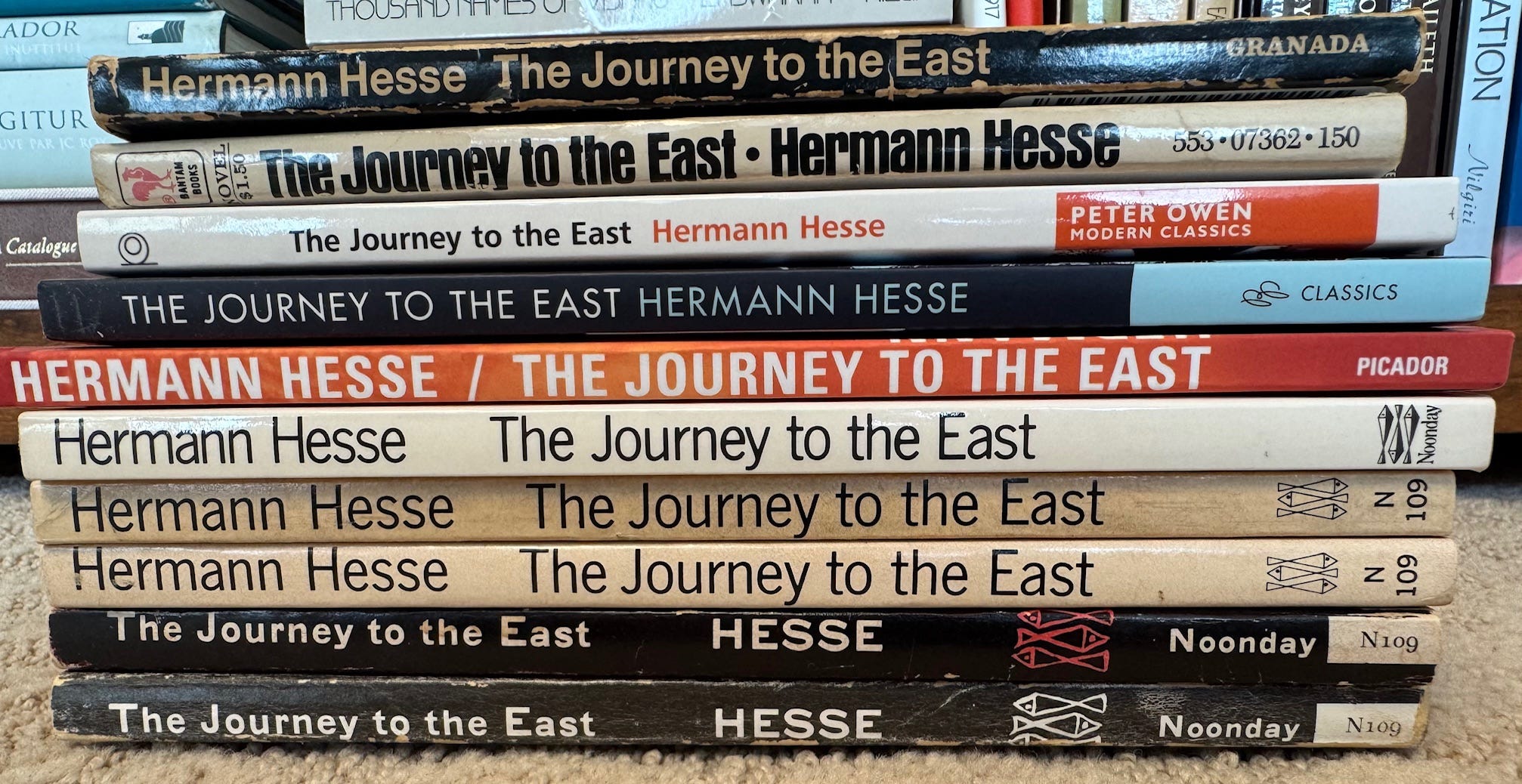
“As it has been my destiny to take part in a great experience, and having had the good fortune to belong to the League and allowed to share in that unique journey, the wonder of which blazed like a meteor and afterwards sank into oblivion – even falling into disrepute – I have now decided to attempt a short description of this incredible journey.”
One of my all-time favorite books! I am hosting a book conversation on it on Thursday, April 16th at 6:00pm ET. You can sign up to join us here!
“People who deny the existence of dragons are often eaten by dragons. From within.”
-- Ursula K. Le Guin
Reading it coincided with the latest episode of The Emerald podcast, on dragons and serpents. From ancient times to modern times, in the ages of the pagans and in the Christian era, we have marveled at, fought, tempted and condemned dragons. We have sought their destruction, their blessing, their fire and their treasure. Donkey even found the love of a Dragon, so perhaps we too can take a step into the dragon’s liar.
Liturgies of the Wild by Martin Shaw (audiobook)
“Can you remember what it feels like to have something come apart in your hands, again and again? The shame in that? The flush of the cheek and the resolve to continue even as you burn with embarrassment. There is no distance left to run, you simply have to stay with it. Within fairy tales, silence can have a variety of qualities and is substantial in its power and influence. When words are formed, they come from the pathos of the weight of the space around them. It’s not just rat-a-tat-tat. Initiatory silence has the quality of the brood whilst the eggs incubate; it has less spillage, it’s refined, there’s more acuity to it. It’s a dimension that religious orders and mythical folk the world over understand. I know a young African girl who deliberately goes into silence once a week for a full day, to steady herself. Confirm her own fundament. It’s to do with a certain deliberateness, a kind of yoga of the soul. It’s not secrecy but privacy. We get thinned out without it, and it’s much easier to fool.”
I pre-ordered this book so it arrived on the day of its release. My friend Sherry Shenoda reminded me that Shaw is best listened to, rather than read. How right she is! His voice and cadence lend heart to his tales.
I liked it, I didn’t love it, although my sense is that’s more to do with me than Shaw. I want to return to the myths myself. Unmediated by interpreters. I want to find out what I make of them myself.
The Big Book of Health and Fitness by Philip Maffetone
“We can break free from the devastating ravages of foods that make us sick and the disease-care system that is more interested in its own financial welfare than in genuine and effective health care. And we can do it by assuming greater responsibility for our own health.”
I found out about Maffetone a dozen years ago through Christopher McDougall’s Natural Born Heroes, one of my favorite all-time books. I read it, implemented much of Maffetone’s lessons, felt great but slowly over the years, fell away. Late last year, I re-committed to improving my health, even if -- given my congenital heart defect -- that improvement was quite modest. That’s okay. The effort matters. The mindset matters. To paraphrase Lord Krishna in The Bhagavad Gita, I must make the effort but leave the results to the Lord.
I won’t delve here into Maffetone’s approach. Some people would love it, others dislike it. I will only say that the closer I follow his counsel, the better I personally feel.
Fixing Your Feet by John Vonhof and Tonya Olson
“So the point here is that you need to put lots of miles on your feet in order to train them for long conditions. You can run 10 miles a day, day after day, and then try to do a 50-miler, and odds are that you’ll have problems. You have 10- to 15-mile feet – not 50-mile feet. This applies to walking, running, adventure racing, hiking, and any activity where you use your feet.”
Since 2020, I’ve experienced a steady stream of foot and ankle issues. It started with a painful rash, which abated. Then came deep soreness and pain. I probably caused some by overuse and poor ramp-up in my training. Some may be due to muscle weakness in my feet, legs and elsewhere. Other factors may include downstream effects of my heart defect. The last three years have proven especially fitful. Lots of foot challenges. I turned to this book not as a panacea, but to remind me of the importance of basics. Things like -- the foot-sock-shoe match matters. And to treat each new shoe purchase as starting over. (Two years ago, fearful New Balance would discontinue the model of shoe I’d been wearing, I purchased 6 pairs. The first two worked fine. Pair #3 killed my feet -- in a debilitating manner. Of pairs #4, #5 and #6, I’ve been able to wear one; the rest I donated to Goodwill.)
If you do adventure or long-distance sports, this book offers a huge wealth of tips and advice. Even for me, it reminded me of the importance of the basics. In 2026, so far, so good with my feet. Hopefully I can slowly ramp up to longer walks and rucks like I was doing until mid-2023.

(This article contains Amazon Affiliate links. As an Amazon Associate, I earn from qualifying purchases, which means that by buying from these links, you are supporting Solvitur Ambulando. Thank you!)
Manchester, William. The Last Lion: Winston Spencer Churchill; Visions of Glory: 1874-1932. New York: Bantam Books Trade Paperbacks, 1983. p. 31.
Despite the fact I already have too many books to read, I added several more thanks to you ; )
Ray
I have never felt any interest in reading Moby Dick beyond a mild desire to have read Moby Dick, and you have just freed me from even that, forever. Thank you, Russell!
Also really want to read Journey to the East and just bought it for Kindle. My schedule is pretty intense at the moment, but hoping to join you for the discussion!