


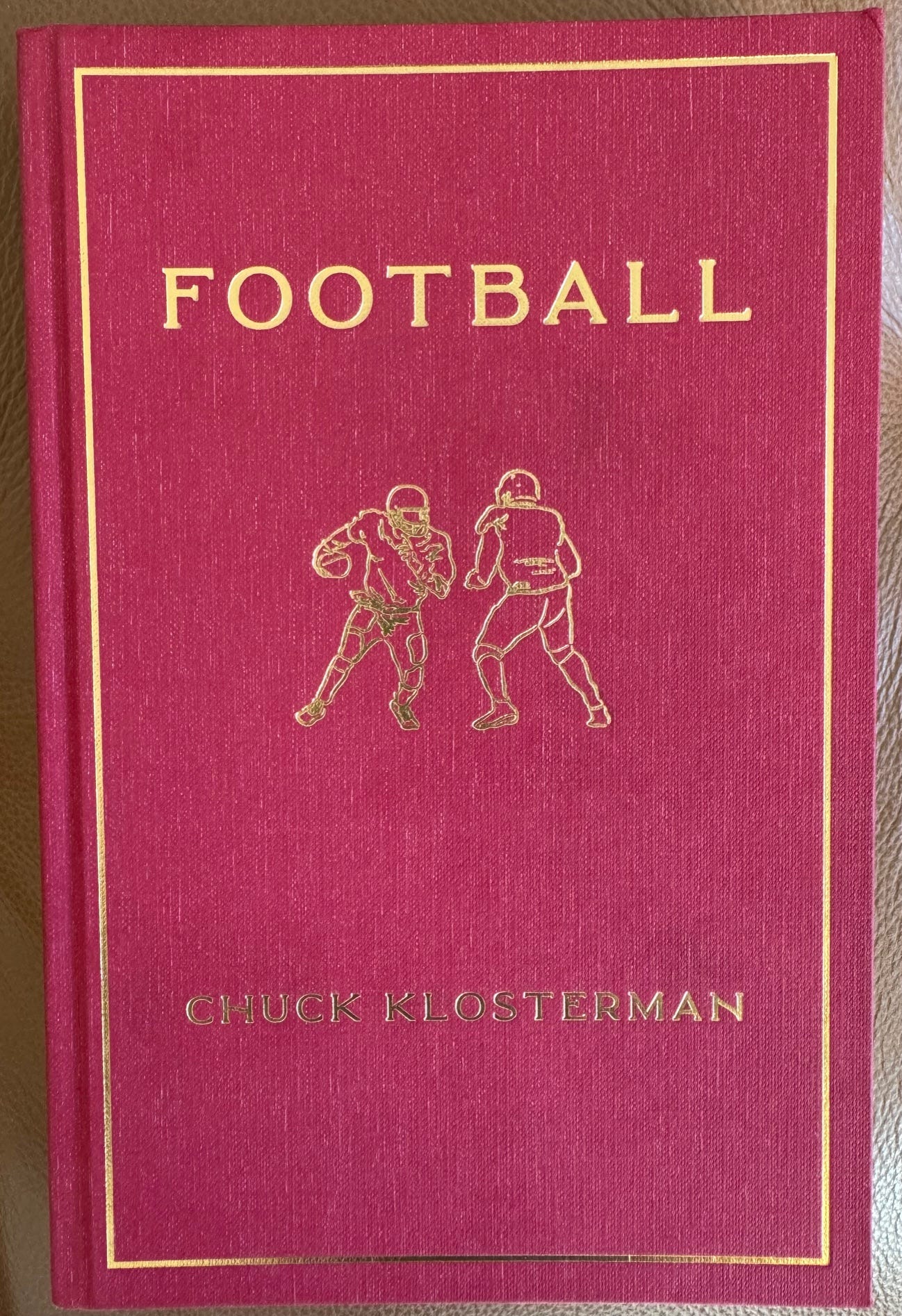
I listened to Klosterman’s interview on the Art of Manliness podcast and decided to check out the book. It goes quickly and Klosterman does an impressive job dissecting an array of football topics:
why football and TV pair perfectly;
what Canadian football got wrong;
why Colin Kaepernick’s protests failed;
the inherent silliness of “America’s Team”;
the crazy devotion to high school football and in Texas;
CTE and the physical, mental and emotional toll on players;
how many black quarterbacks – and kickers – there should be;
the nature of greatness and who’s the greatest football player of all time;
and why football, amidst its greatest stranglehold on American culture, is doomed to crash.
Here’s Klosterman contemplating these issues, as only he can:
“Should strangers be allowed to do very dangerous, very popular things?”
“There’s no reason to value life if we’re not going to value living.”
“Bookmakers know things that cannot be known.”
“Pervasive institutional control, so entrenched that it’s become unremarkable, is both the facilitator for society’s overall enhancement and the reason so many individuals within that society feel alienated by the very things that make life easier. Everything was upgraded and nothing got better....Football is a chaotic replication of bureaucratic life.”
“What is already happening, and what will continue to happen, is that the evolution of American culture is in direct opposition to the culture of American football. The sport, in almost every way, is a contradiction of what enlightened people are supposed to want. It conflicts with how modern people are socialized to think, subverting the symbolic meaning of what football represents.”
“The larger problem is this widespread social conviction that humanity is always improving, and that any greatness we see or experience must therefore represent the highest order of those qualities. I think that’s backward.”
“The Dallas Cowboys’ designation as “America’s Team” is the most remarkable modifier in all of sport, a disposable marketing term that became a mystery of faith. It’s an irony so ironical that describing its ethos feels like the epigraph of a Joseph Heller novel: Everyone accepts it, but no one believes it.”
“Canada did its best, but Canada fucked up. And now the Canadians just have to live with it.”
Listening to the podcast and reading the book coincided with something I’ve noticed in the last few years -- my interest in football has declined precipitously. I’ve explored many possible reasons for that diminishment: kids and family life; having two girls and despite the best marketing efforts of the NFL, they simply ain’t that into it; the fact I picked the wrong 35 years to root for the Washington Redskins - Football Team - Commanders (and what a terrible name they ended up with); the fact I don’t play fantasy football or bet on any sports (or really anything); the increasing moral dubiousness of supporting men playing a sport that undoubtedly damages their health, however enriching in many ways they may find it; among others I’ve pondered.
But none of those quite seemed correct. Klosterman’s theory that the conflicting values of upstanding America and of football also didn’t explain my agitation. Maybe they fed into my diminishing interest but none really explained it.
Instead, my tepid feelings come as a reaction to the increasingly pervasive and fervid reach r of the sport itself. The almost imperialism of football within American life – specifically the NFL, but also college football – demanding attention. In the 1950s, NFL teams played 12 regular season games per year. In 1961, it became 14 games. As I was growing up, the regular season lasted 16 games. Now it’s 17 games across 18 weeks. And if you think they’re stopping there, I wouldn’t take that bet. Soon, it’ll be 18 regular season games, then 20. The American market seems saturated, so the NFL looks abroad – Mexico City, Frankfurt, Munich, Berlin, Madrid, São Paulo, London and Dublin have all hosted games in the past three seasons, with Paris on deck for the 2026 season.
From one long-form NFL show — Sunday NFL Countdown on ESPN — and pre-game shows, we now have dozens of daily and weekly pro football shows to watch, plus literally hundreds of national, syndicated or local radio shows. (The Kevin Sheehan Show in DC produced one of my all-time favorite callers in 2013: “Uh, Kevin, I’m looking at this roster and I don’t see how this team goes anything except 16-0.” Kevin and his compadres laughed him off the show. The Redskins finished the season 3-13.)
As I was growing up in the 1980s and 1990s, the football season and Super Bowl dominated media coverage of the game. Then came increased attention on the annual Draft, which led to greater scrutiny of the Combine. Free agency and the salary cap and exploding salaries added interest to the personal and economic stories of the players. The NIKE-fication of the University of Oregon football team, with new jersey and helmet designs each week, spilled over to all of college football and into the NFL. Every team releases a story about the uniforms it’ll wear that week. Mean Joe Greene and Jack Lambert must be losing their minds. They wore one uniform of one color every game, every season – brown mud.
I feel like a player dogpiled by ads, marketing, media, the League itself, players: all demanding more, more, more attention from me. Watch me, see us, buy this, bet on that, support our social justice causes, wear our throwbacks (except the Redskins), pay attention NOW and ALWAYS to football!
And I feel tired of it all, tired by it all. I don’t want to keep up, I don’t want to watch, I don’t want to bet. It feels like yet another Dave Matthews Band album. I’m exhausted and I’m making the only act of protest I can – turning off the TV more and more.
When I purchased Football, I also bought two other books on the game: The Football 100, examining the best pro players of all-time; and Why We Love Football by Joe Posnanski. After Klosterman’s Football, true to my sentiments about the game itself, I put the other two away on my bookshelf, unopened and barely touched. One book on football was more than enough for this year.
And I take comfort that pitchers and catchers begin reporting on February 10th.

Don’t get me wrong. I’ll still watch the Super Bowl this weekend (Go Patriots). I still think the Hall of Fame voters should be publicly censured for not voting in Bill Belichick on the first ballot. I’ll still laugh at these football quotes:
“I mean, it’s like the hokey pokey. Put your right foot in, you take your right foot out, you put your right foot in, you shake it all about. You do the hokey pokey and turn yourself around. Boom! That’s what it’s all about.” – “John Madden” talking with David Letterman, not quoted in Klosterman’s book.
“When you see butt sweat like that, you know that guy is giving his all.” – John Madden, also not quoted in Klosterman’s book.
“This is a football.” – Reportedly said by Dan Dierdorf. Or John Madden. Or in spoofs of them. Also not quoted in Klosterman’s book.
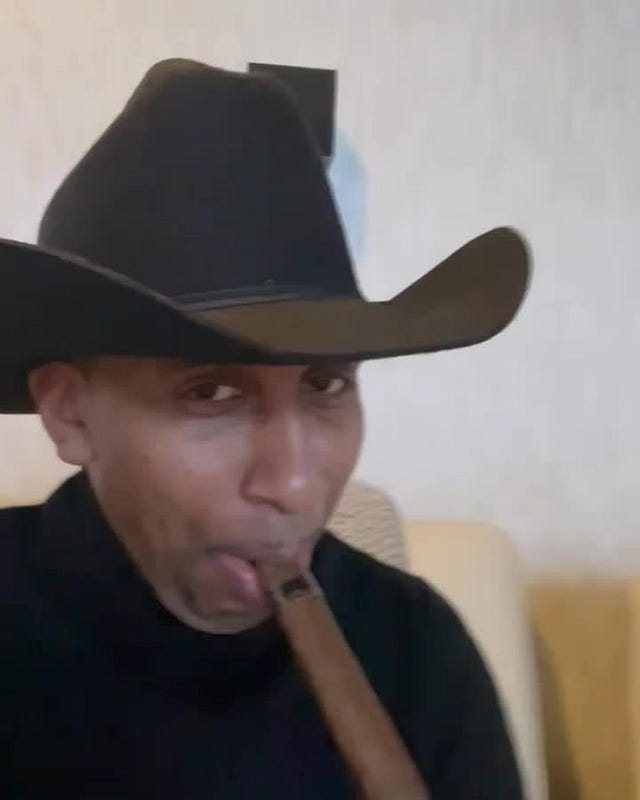
And some of my favorite times next season, and every season, will be when Stephen A. Smith dons his cowboy hat and cigar to laugh his ass off following another loss by the Dallas Cowboys.
 Tiktok failed to load.
Enable 3rd party cookies or use another browser

Miscellaneous Miscellany
Henry Oliver’s 10 reasons to read great literature in 2026 — and every year.
Last year, I wrote a review of the war diaries of Lieutenant General Geoffrey Keyes, an important aide to General George S. Patton, among others, during the Second World War, for the Army Historical Foundation.
Last summer, Ferris Bueller’s vest sold for pretty much the cost of an average American home.
A good beginner’s guide to the Ramayana and Mahabharata. (h/t Marginal Revolution)
Brian Potter investigates how China became the world’s largest shipbuilder.
Cal Newport examines those morning routines you think you should be doing.
New books in my library: The Philokalia: A Selection; Jane Eyre (thanks, Charles!); Emma: 200th Anniversary Annotated Edition; What Would Socrates Say? (thanks, Neil!); East Goes West (thanks, Mark!); The English and Their History; and Swann’s Way (thanks, Jesse!)
Oh, you’ve never seen Tom Hanks and Dan Aykroyd rap? Well, now you have.
(This article contains Amazon Affiliate links. As an Amazon Associate, I earn from qualifying purchases, which means by buying from these links, you are supporting Solvitur Ambulando. Thank you!)
First, let's clear the air. Go Seahawks!
For 95% of my adult life, I would learn the names of the Super Bowl teams somewhere around halftime of the game. I was there for the ads & halftime.
Then it happened.
We moved to Philly. Deep, deep in the heart of Go Birds! town.
There was a choice to be made. Suffer supreme social isolation, or start to watch football.
(And to complicate family matters - our son worked for the NFL - on one of those endless TV shows, where they've elevated mindless chatter to an ignored artform.)
In the grocery store, most employees wear their green team shirts. The Eagles song blasts from the sound system. I learned that, in season, one greets people on the street with..no, not hello...we nod and say "Go Birds" like we belong to some elite club.
So, I find myself watching young men undergo immense physical strain, huge fan pressure and capricious weather to chase a funny-shaped ball (that may have been deflated a bit in certain games...Go Seahawks) over a line at the end of a field.
But, the real reason to watch? It's about community. People come together over sports, and that is not nothing. I'll take community wherever I can find it.
Speaking of halftime...in these troubled times.... "Me duele el corazón y mi mente está acelerada, pero seguiré adelante." - Bad Bunny
“My heart is aching, and my mind is racing, but I'll keep pushing through."
Couldn't have said it better myself! Saturation deadened me.