


To honor Wendell Berry, who passed away in August, I’m hosting two book conversations on his novel The Memory of Old Jack. To learn more, you can read my announcement. To sign up for one of the 90-minute sessions:
Tuesday, November 10th at 2:00pm GMT (9:00am ET)
Thursday, November 12th at 6:00pm ET

Ah, September! Such a glorious month for reading. My Q3 reading train rolled on.
If you missed Part 1 of my reviews of the books I read in Q3, here it is:


13. The Mantle of the Mystic by Eknath Easwaran
Father John’s way of helping me to learn to speak English was to encourage me to enter the college debate program. I wanted to do everything I could to please him, and that gave me the motivation to work extremely hard. He wasn’t in the habit of paying compliments, and that didn’t trouble me because my grandmother wasn’t either. Instead, he supported me in quiet ways.
“You have probably heard there is an intercollegiate debate coming up.”
I had. I knew it covered the whole region and was the most prestigious debate we could compete in....
“I want you to represent this college.”
I was overwhelmed; I literally couldn’t believe it. What if I let him down? I must have muttered something to that effect because he cut me off with a gesture. “I’ll be the judge of whether you are equal to it,” he said.
At the end of the day, to my surprise, the panel of judges not only gave me and my partner the intercollegiate trophy; they gave me first place for individual elocution.
In his own words, Easwaran relates the story of how he gradually took to the spiritual life, a path that culminated in his founding of the Blue Mountain Center of Meditation in California. All along, his grandmother, whom he later credits as his spiritual guru, and others, like Father John, see more in him than he sees in himself. Reading this book reminded me of Tyler Cowen’s view:
“At critical moments in time, you can raise the aspirations of other people significantly, especially when they are relatively young, simply by suggesting they do something better or more ambitious than what they might have in mind. It costs you relatively little to do this, but the benefit to them, and to the broader world, may be enormous. This is in fact one of the most valuable things you can do with your time and with your life.”
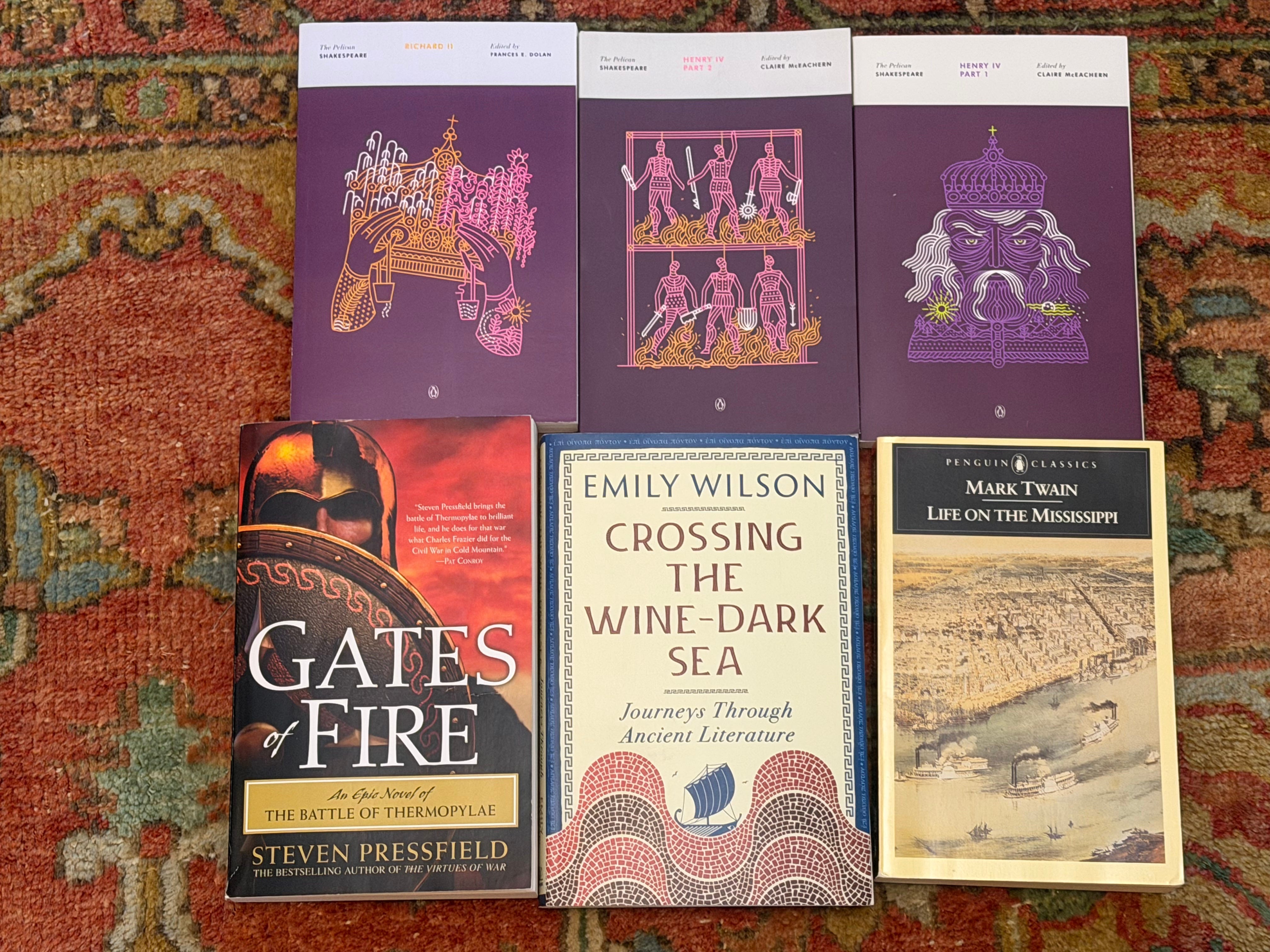
14. Life on the Mississippi by Mark Twain (audiobook)
“Then comes Sir Walter Scott with his enchantments, and by his single might checks this wave of progress, and even turns it back…. But for the Sir Walter disease, the character of the Southerner – or Southron, according to Sir Walter’s starchier way of phrasing it – would be wholly modern, in place of modern and medieval mixed, and the South would be fully a generation further advanced than it is. It was Sir Walter that made every gentleman in the South a Major or a Colonel, or a General or a Judge, before the war; and it was he, also, that made these gentlemen value these bogus decorations. For it was he that created rank and caste down there, and also reverence for rank and caste, and pride and pleasure in them…. Sir Walter had so large a hand in making Southern character, as it existed before the war, that he is in great measure responsible for the war.”
Like the great epics and poetry, Twain makes for excellent listening. This book riveted me for days. Funny, sarcastic, serious, upbeat, witty, offensive - Twain spares no one, including famous authors like Sir Walter Scott. You know what you’re getting with this book: unvarnished Mark Twain.
15. Gates of Fire by Steven Pressfield
This was the first and only time I saw Bruxieus truly, physically angry. He seized me by both shoulders and shook me violently, commanding me to face him. “Listen to me, boy. Only gods and heroes can be brave in isolation. A man may call upon courage only one way, in the ranks with his brothers-in-arms, the line of his tribe and his city. Most piteous of all states under heaven is that of a man alone, bereft of the gods of his home and his polis. A man without a city is not a man. He is a shadow, a shell, a joke and a mockery.”
We read this for the gents book club. I kept coming back to the few scenes in Athens and about the Athenians. Yes, the Spartans performed heroic deeds at Thermopylae. But it took a coalition of Greek cities united in common cause to turn back the Persians. Pressfield is too good a writer to have no reason for including Athens in a book predominantly about Sparta. I kept wondering if he included Athens to remind us, his readers, that other paths to victory exist besides the Spartan. And that one way of life isn’t necessarily incompatible with cooperation with another way.
16. Crossing the Wine-Dark Sea by Emily Wilson
“[R]eading this diverse body of texts in English translation risks creating a false kind of homogeneity.”
“It [Stoicism] is a philosophical and psychological system designed to comfort the rich and powerful for any perceived limits on their power, by assuring them that they are, after all, in control of everything that matters. It also conveniently promotes an idea of ‘virtue’ that is compatible with ignoring or enabling the suffering of everyone else in the world.”
“Readers could be forgiven for thinking there’s nothing new to learn about the ancient world. If scholars want any of these things to change, we need to begin training ourselves and our students not only how to conduct careful, thorough, generative research, but also how to engage with the public beyond the academy. We must show members of the intelligent reading public the respect they deserve, by offering nuanced, clear, interesting analyses of antiquity in all its glorious, alien complexity. To do that, above all, we need to learn how to write.”
With essays on topics ranging from translating the Odyssey and the mysteries of Sappho’s poetry, to the life of Demosthenes, plus a supreme takedown of the modern hyperventilation on Stoicism, Wilson delivers a forceful left-of-center look at the classics. With references as diverse as Cardi B, Christopher Logue, Edith Hamilton, and The Simpsons, she takes readers on quite a ride. I appreciated the bodyslam of modern interpretations of Stoicism, as something about Ryan Holiday and company’s version of the philosophy never struck me as quite right. Wilson does a better job than I’d been able to in placing her finger on what has troubled me.
Beyond her shiv of Stoicism, I appreciated her dive into the nuances of the art of translation, offering numerous examples from ancient writers and modern translators. I came away reflecting on the successes and failures of every translator, to a greater or lesser extent. Her essays also reinforced a worry I have nurtured as I have read more literature and scripture in translation, a point emphasized by Ananda K. Coomaraswamy: unless you immerse yourself in the original language, you don’t really know or understand the work being read. No translation can give you that – only living the language and culture in which it was written can truly convey knowledge. She also urges classicists and all scholars to do something we are told will not matter so much in the not-too-distant future. She prods them – us – to re-commit ourselves to that skill which has made the modern world a miracle and a glory in so many ways, and which I believe will remain a critical human skill: “above all, we need to learn how to write.”
17. King Richard II by William Shakespeare
18. King Henry IV Part 1 by William Shakespeare
19. King Henry IV Part 2 by William Shakespeare
“RICHARD
I have been studying how I may compare
This prison where I live unto the world,
And for because the world is populous
And here is not a creature but myself
I cannot do it….
Thoughts tending to ambition, they do plot
Unlikely wonders: how these vain weak nails
May tear a passage through the flinty ribs
Of this hard world my ragged prison walls,
And, for they cannot, die in their own pride.
Thoughts tending to content flatter themselves
That they are not the first of Fortune’s slaves,
Nor shall not be the last, like silly beggars
Who, sitting in the stocks, refuge their shame
That many have and others must set there,
And in this thought they find a kind of ease,
Bearing their own misfortunes on the back
Of such as have before endured the like.
Thus play I in one person many people,
And none contented. Sometimes am I king,
Then treasons make me wish myself a beggar,
And so am I.”– King Richard II, Act V scene 5
“PRINCE HENRY
I know you all, and will awhile uphold
The unyoked humour of your idleness.
Yet herein will I imitate the sun,
Who doth permit the base contagious clouds
To smother up his beauty from the world,
That when he please again to be himself,
Being wanted, he may be more wondered at,
By breaking through the foul and ugly mists
Of vapours that did seem to strangle him.
If all the year were playing holidays,
To sport would be as tedious as to work;
But when they seldom come, they wished-for come,
And nothing pleaseth but rare accidents.
So, when this loose behaviour I throw off
And pay the debt I never promisèd,
By how much better than my word I am,
By so much shall I falsify men’s hopes,
And like bright metal on a sullen ground,
My reformation, glittering o’er my fault,
Shall show more goodly and attract more eyes
Than that which hath no foil to set it off.
I’ll so offend to make offence a skill,
Redeeming time when men think least I will.”– King Henry IV Part 1, Act I scene 2
“KING HENRY V
I know thee not, old man. Fall to thy prayers.
How ill white hairs become a fool and jester!
I have long dreamed of such a kind of man,
So surfeit-swelled, so old and so profane.
But being awake, I do despise my dream.
Make less thy body hence and more thy grace,
Leave gormandizing; know the grave doth gape
For thee thrice wider than for other men.
Reply not to me with a fool-born jest.
Presume not that I am the thing I was,
For God doth know, so shall the world perceive,
That I have turned away my former self,
So will I those that kept me company.”– King Henry IV Part 2, Act V scene 5
Much of the drama in Shakespeare derives from the characters not accurately seeing themselves, their world, or both. Most of his main characters, in fact, lack self-knowledge, and the unfolding drama ends in either remedy or destruction.
As I read these three plays, it seemed clear that neither Richard nor Henry Bolingbroke, who becomes Henry IV, really understands himself. Or, rather, his understanding of himself does not square with reality. In Richard’s case, his capriciousness – a violation of the law – ill suits a monarch. In Henry’s case, his usurpation of the crown from Richard taints how he views himself. It also smacks of the same sin he condemned Richard for – capriciousness – and sets a bad example for a realm saturated with crime, hooliganism, factionalism and disregard for the law. As above, so below, right?
Only the coming of King Henry V solves the problem of capriciousness in sovereign and country. Contrary to many readers’s sense of Prince Hal’s waywardness under Sir John Falstaff and redemption after assuming the kingship, he knows exactly who he is from early on. We read it in Act I scene 2 of King Henry IV Part 1. Hal has no illusions about himself or reality. It is the blustery Falstaff who stupidly assumes an overarching sway over the lad. Falstaff may know himself – I haven’t made up my mind on that question – but he poorly perceives the world as it is.
Many commentators vehemently disagree with me. No less a figure than Harold Bloom views Falstaff, along with Hamlet, as the character most responsible for the “invention of the human.” I disagree. I have hated Falstaff since I first read the Henriad in college, and I detest him now. It is not only Falstaff’s upending of order in the realm - once again beset by faction and lawlessness, echoing the religious strife of Elizabeth I and Mary, Queen of Scots, as the Catholics and new Protestants jockeyed for control of English church, crown and state. It is Falstaff’s inability to perceive his own destructiveness to his friends and to the realm. He needed inner reforming far more than the future king.
But that’s my view. For the opposite view, Bloom’s Shakespeare: The Invention of the Human makes for fascinating reading.
20. Henry V by Dan Jones
“[T]his long apprenticeship has also allowed Henry the freedom to make mistakes, to try on different political guises, to work out who to trust, and to grow as sure as he can be of how to approach kingship when it belongs to him in full. In March 1413 Henry ascends to his father’s throne better prepared for rule than any king in living memory.”
My brother Brooken gave me this book for Christmas two years ago. Before I returned to Shakespeare’s play Henry V, I wanted to read about the real man.
The real Henry makes for a more intriguing study than the Shakespeare character. For one, the domestic and international politics he actually faced demanded far more nuance and skill than Shakespeare shows. For another, Henry comes across as both more likable and more detestable than in Shakespeare. Following the civil unrest in the times of Richard II and his father, he sought to restore order to England and to extend reconciliation to many of the factions behind it. He tried to heal England. He also ruthlessly pursued sieges in France that led to thousands of grisly deaths, both in those towns and in his own army. And for what? To uphold a flimsy claim to the French crown? To punish the French for their own civil strife, as a self-anointed scourge of God?
I read this book at a good time – after Henry IV Parts 1 and 2 but before Henry V. Shakespeare wrote legendary plays and, if I may say so, sophisticated works of political theory, philosophy, and even theology. But he necessarily simplified the world and the characters in his plays. Reality is far more complicated and has its own hard lessons to teach us.
I enjoyed all the books this quarter. In Q4, I will start with Wild Work, co-edited by my friend Sophie A. H. Osborn, and will be interviewing her about it in October. And then? Where will the reading winds blow? I will find out soon.

If this post was worth your time, two things help most: leaving a comment or forwarding it to one person.
(This article contains Amazon Affiliate links. As an Amazon Associate, I earn from qualifying purchases, which means that by buying from these links, you are supporting Solvitur Ambulando. Thank you!)