


Welcome to Solvitur Ambulando, which means "Solve It By Walking." On this journey, we explore the alchemic potency of walking for sorting through life's puzzles, exploring our world, and transforming ourselves. Like a good walk, you will encounter distinctive ideas, remarkable people and gorgeous scenery. I hope you will enjoy a beautiful walk today. And if you like what you read and hear, I’d love to have you along.
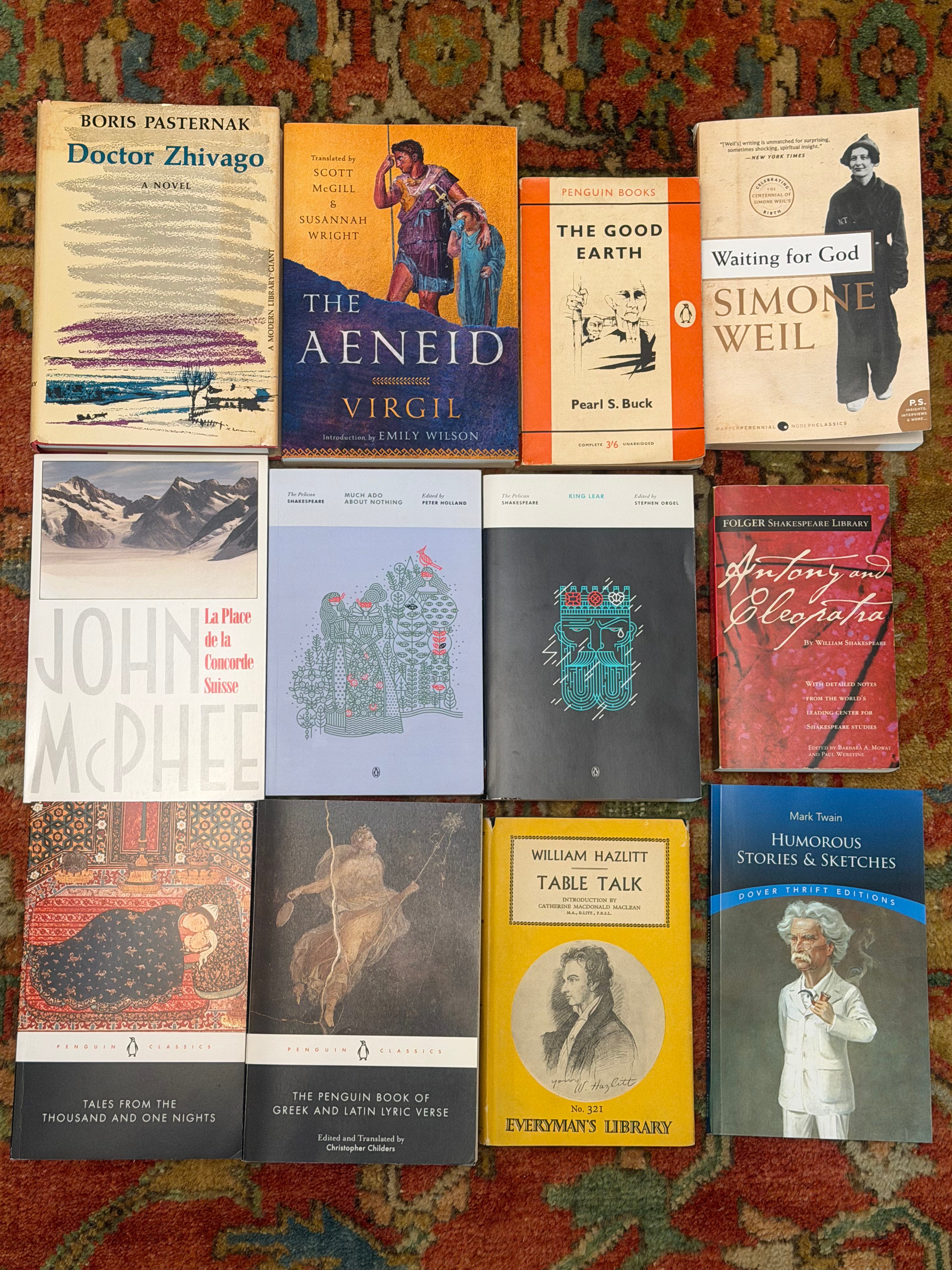
Another fun quarter — or two-thirds — of reading! Bring on September!

1. Antony and Cleopatra by William Shakespeare
“SOLDIER
“O noble emperor, do not fight by sea!
Trust not to rotten planks. Do you misdoubt
This sword and these my wounds? Let th’ Egyptians
And the Phoenicians go a-ducking. We
Have used to conquer standing on the earth
And fight foot to foot.”ANTONY “Well, well, away.”
[Antony, Cleopatra, and Enobarbus exit.]
SOLDIER
“By Hercules, I think I am i’ th’ right.””– Act III, scene vii
The Kentucky Shakespeare Festival is one of the longest running summer Shakepeare in the Park programs in the country. I read Antony and Cleopatra to prepare to see its production in July. And the timing also coincided with my daughter Beatrice and I listening to Ben Wilson’s podcast on Cleopatra. I came away dissatisfied with the Festival’s portrayal of Cleopatra. Early, she resembles, well, a teenage Swiftie. Later, she becomes tyrannical. Shakepeare’s portrayal (which seems to agree more with her actual life, as reported by Wilson) comes across with more nuance, sophistication and savvy. Cleopatra knew Rome coveted Egypt, and she deployed her wiles first with Julius Caesar and then with Mark Antony to preserve a modicum of freedom. But Caesar’s death and Antony’s bungling cut off avenue after avenue of escape. I do believe Clepatra and Antony loved each other, beyond the political sensibilities of their alliance. But Octavian proved that love does not, always, conquer all.
2. Much Ado About Nothing by William Shakespeare
“BEATRICE “And a good soldier to a lady, but what is he to a lord?”
MESSENGER “A lord to a lord, a man to a man, stuffed with all honorable virtues.”
BEATRICE “It is so indeed. He is no less than a stuffed man; but for the stuffing – well, we are all mortal.”
LEONATO “You must not, sir, mistake my niece. There is a kind of merry war betwixt Signor Benedick and her. They never meet but there’s a skirmish of wit between them.”
BEATRICE “Alas, he gets nothing by that! In our last conflict four of his five wits went halting off, and now is the whole man governed with one, so that if he have wit enough to keep himself warm, let him bear it for a difference between himself and his horse, for it is all the wealth that he hath left to be known a reasonable creature. Who is his companion now? He hath every month a new sworn brother.”
MESSENGER “Is’t possible?”
BEATRICE “Very easily possible. He wears his faith but as the fashion of his hat; it ever changes with the next block.””
— Act I, scene i
I have loved this play since I first read it and saw it performed while studying abroad at DeMontfort University in Leicester. I love Beatrice’s bravery and strength – she is perhaps the second-strongest female character in Shakespeare, after, well, keep reading. I love Beatrice so much that we named our first-born daughter after her (and for Dante’s guide into Paradiso). I laughed at her wit and cleverness. And I despaired at her instruction to Benedick, “Kill Claudio.” For while this ranks as one of Shakespeare’s comedies, we should recall how perilously close it comes to going completely off the rails. Don John provides the proximate push to cause the trouble – we should guard ourselves against the malevolence of others. But really, most of the characters – and most of us? – are deceived because of themselves. They see what they wish to see. They do not have patience to examine the situation more closely. They do not ask questions of the world or themselves. As a writer with an entire newsletter dedicated to reflection, pausing and slowing down, Much Ado About Nothing exemplifies the daily need to ponder our world and our place in it more carefully.
My friend Charles and I went to Cincinnati to join a discussion of the play by the Catherine Project. Reading, discussing or watching the play will never waste your time.
3. King Lear by William Shakespeare
“CORDELIA
“Peace be with Burgundy.
Since that respects of fortune are his love,
I shall not be his wife.”KING OF FRANCE
“Fairest Cordelia, that art most rich being poor,
Most choice forsaken, and most loved despised,
Thee and thy virtues here I seize upon.
Be it lawful I take up what’s cast away.
Gods, gods! ‘Tis strange that from their cold’st neglect
My love should kindle to inflamed respect.
Thy dowerless daughter, king, thrown to my chance,
Is queen of us, of ours, and our fair France.
Not all the dukes of wat’rish Burgundy
Can buy this unprized precious maid of me.
Bid them farewell, Cordelia, though unkind.
Thou losest here, a better where to find.”LEAR
“Thou hast her, France; let her be thine, for we
Have no such daughter, not shall ever see
That face of hers again. Therefore be gone,
Without our grace, our love, our benison.
Come, noble Burgundy.[Flourish. Exeunt Lear, Burgundy, Cornwall, Albany, Gloucester, and Attendants.]
FRANCE [To Cordelia]
“Bid farewell to your sisters.”
CORDELIA
“The jewel of our father, with washed eyes
Cordelia leaves you. I know you what you are;
And, like a sister, am most loath to call
Your Faults as they are named. Love well our father.””– Act I scene i
We named our oldest daughter Beatrice and our second daughter Cordelia -- perhaps the strongest female character in Shakespeare. When Cordelia learned I was reading Much Ado About Nothing, she asked:
“Why aren’t you reading King Lear, about me?”
“I can read King Lear. You know it’s a tragedy, right?”
“Yes, you’ve told me. So, lots of characters die?”
[Me, hesitantly, sensing a trap] “Yes, they do.”
“But King Lear lives, right?”
[Me, silent]
“Dad! King Lear lives, right?”
[Me, resigned, quietly] “No, King Lear dies.”
“What!? He dies!?” [Long pause] “Wait...does Cordelia die?”
[Me, silent]
“Dad! Cordelia dies too!? You named me after a character who dies?! Why did you do that?”
[Exeunt Cordelia, storming off]
We named you Cordelia because she is brave and just, loving and truthful. May you always be so, Cordelia.
4. La Place de la Concorde Suisse by John McPhee
“You see the big closed doors of a building that appears to be a garage for snowplows. But why would snowplows need to be surrounded by such a high fence and so much barbed wire? Possibly because they plow snow with ten-and-a-half-centimetre cannons.”
Someone told me I’d enjoy the books of John McPhee and the essays of William Hazlitt. I’d read a bit of McPhee before – Coming Into the Country, about Alaska, several years ago. This book, about the Swiss army, written in 1984, seemingly at the height of the Cold War, surprised me. I didn’t recall McPhee being so funny. Plus, ever since I had visited South Korea more than 20 years ago on a work trip, I’d assumed that I had some sense as to why people go to war: because they literally cannot understand each other. But McPhee writes about German Swiss people in the French Swiss area not understanding the language and vice versa. And yet these people have created perhaps the most stable country on earth, despite the language differences. How? Through shared purpose: a common cause of defense and non-aggression. I expected to learn something from McPhee’s prose. I did not expect to find a source of hope in our fragmented world.
5. On Going a Journey by William Hazlitt
“One of the pleasantest things in the world is going a journey; but I like to go by myself. I can enjoy society in a room; but out of doors, nature is company enough for me. I am therefore never less alone than when alone.”
I mean, I expected to love this essay. About walking? I mean...cough, cough...I write about walking, walk a lot and enjoy reading about walking. Philosophical? Um, golf clap, yeah, I love me a writer with a philosophical bent. About the virtues of silence and peace? Count me in.
Annnnnddd, I couldn’t stand On Going a Journey. Too syrupy, too fluffy, too sentimental. The Romantics seem poorly grounded for people who supposedly loved the earth so much.
6. The Penguin Book of Greek and Latin Lyric Verse edited and translated by Christopher Childers
“Zeus sees everyone who carries crime
deep in his heart: all is revealed in time”
– Solon“But if oxen had hands, or horses or lions had them,
or could draw with their hands and make art like the art of humans,
the horses would make their deities look like horses,
the oxen would make them like oxen, and each would picture
their gods with the same sorts of bodies as they have themselves”
– Xenophanes
At the start of the year, I wrote an “Aspirational list of books” I hoped to read. The list included “at least a little poetry.” In Q2 I wanted to buy no books. But rambling through Dolly’s Bookstore in Park City, Utah, I came across this volume and went for it. I regretted breaking my vow of no new books zero percent, and I began reading it that night. I made it about halfway and enjoyed it quite a lot, given how little poetry I usually read in a year. Two aspects of it stood out. First, Childers spent 13 years reading and translating these poems, often fragments – what lovely yeoman’s work, and that love shines through. Second, many of these poets recall The Iliad and The Odyssey. You really cannot read them without knowing and appreciating, if not loving, Homer.
7. Tales from the Thousand and One Nights translated by N.J. Dawood
“For many years after my return I lived joyfully in Baghdad, feasting and carousing with my boon companions and reveling away the riches which my far-flung travels had earned me. But though I was now past the prime of life, my untamed spirit rebelled against my declining years, and I once again longed to see the world and travel in the lands of men. I made preparations for a long voyage and, boarding a good ship in company with some eminent merchants, set sail from Basrah with a fair wind and a rich cargo.”
– “The Last Voyage of Sindbad the Sailor”
The economist and writer Tyler Cowen wonders whether stories make us stupider. In this case, the 1,001 tales of Shahrazad to her husband the King postponed the King putting her to death for another three years. They eventually secured her release from his death sentence. Perhaps stories do make us stupider, and we should beware. But perhaps they also make us more merciful and joyful, and we should rejoice.
8. Doctor Zhivago by Boris Pasternak
“Then he noticed that a change had taken place in the room. At the opposite end a new visitor had been added. Yuri Andreevich recognized Antipova at once. She was sitting with her back turned to the front tables, at one of which the doctor had placed himself, and talking in a low voice with the sick librarian, who stood bending towards Larissa Fyodorovna and exchanged whispers with her. This conversation must have had a beneficial influence on the librarian. She was instantly cured not only of her annoying cold, but also of her nervous apprehension. Casting a warm, grateful glance at Antipova, she took away the handkerchief that she kept pressed to her lips all the time and, putting it in her pocket, went back to her place behind the counter, happy, confident, and smiling. This scene marked by touching details did not escape some of those present. From all sides of the room, people looked sympathetically at Antipova and also smiled. By these insignificant signs, Yuri Andreevich ascertained how well-known and loved she was in the city.”
I read along with my friend Cams Campbell’s slow reading of the book. I’m glad I did. Cams knows Russian and added innumerable language, translation and setting details of the book, massively enriching it. Such a tough, hard, sad novel. My heart broke for Yuri, Lara, and many characters. And for Boris Pasternak. And, perhaps most of all, for the Russian people. Thank you, Cams, for an outstanding slow-reading experience!
9. The Aeneid by Virgil translated by Scott McGill and Susannah Wright (audiobook)
“The rising Dawn had left the sea behind.
Though anxious to take time to mourn his men
and badly shaken by the loss of life,
Aeneas rose at daybreak and fulfilled
the vows he owed the gods for victory.”
Over the past few years, I have loved listening to audiobooks of The Iliad and The Odyssey. I’ve begun reading The Aeneid several times over the past 20 years but never gotten far. I figured listening to it would aid my engagement with the story. It did, but I enjoyed The Aeneid far less than either works of Homer. Why? For one, The Aeneid simply falls short of them as an epic tale. And Aeneas comes across as a far more passive hero than Achilles or Odysseus or other Greek heroes from Homer. When it comes down to it, I suspect my preference derives from something perhaps a bit mystical and also potentially irrelevant: we really have no idea who Homer was, and his epics come to us from long before the days of written storytelling. He stands behind a cloud, a fog of dusk, which modern science and archeology have not illuminated a whit. We know who created this tale of Aeneas and that he wrote it down. We know the man and some of his motivations. We can guess at possible motives, if we wish to take a Straussian examination of the text. But that’s academic, and a far less scintillating mystery than: Who was Homer and where did his epics come from?
10. The Good Earth by Pearl S. Buck
“[S]he lay dying on her bed for many months. All through the long months of winter she lay dying and upon her bed, and for the first time Wang Lung and his children knew what she had been in the house, and how she made comfort for them all and they had not known it.”
My Aunt Mary and her husband David gave me a copy of this book and urged me to read it a few years ago. So I selected the book for the latest gathering of the gents book club. I felt gratified that I loved it, and so did everyone. The entire novel reminded me, again and again, to keep asking two questions I do not ask enough:
Who or what do I not see?
What is not working for me any longer?
11. Waiting for God by Simone Weil
“And my greatest desire is to lose not only all will but all personal being.”
“As for the spirit of poverty, I do not remember any moment when it was not in me....I fell in love with Saint Francis of Assisi as soon as I came to know about him.”
“I have an extremely severe standard for intellectual honesty, so severe that I never met anyone who did not seem to fall short of it in more than one respect; and I am always afraid of failing in it myself.””
“The key to a Christian conception of studies is the realization that prayer consists of attention.”
My friend J_ kept sending me photos of pages and his notes while he was reading the book. After about the third text, I felt compelled to order the book for myself. Upon receiving it, I set upon it instantly. Weil quickly joined the ranks of Ananda K. Coomaraswamy, Marco Pallis, and Whitall Perry as mystics and theologians of whom I need more in my life. Let me stop there, because I do not yet know what else to say about her, except perhaps this: more of us should read more of her. Thank you, JG.
12. Humorous Stories & Sketches by Mark Twain
“The humorous story is told gravely; the teller does his best to conceal the fact that he even dimly suspects that there is anything funny about it; but the teller of the comic story tells you beforehand that it is one of the funniest things he has ever heard, then tells it with eager delight, and is the first person to laugh when he gets through. And sometimes, if he has had good success, he is so glad and happy that he will repeat the “nub” of it and glance around from face to face, collecting applause, and then repeat it again. It is a pathetic thing to see.”
My wife and I began listening to Ron Chernow’s biography of Twain as we rolled to and from the Carolinas this summer. We’ll enjoy several summers of this, as the book runs to over 44 hours. The first few hours found me laughing out loud at many points. I’d forgotten how damn funny Twain could be. I’d forgotten how much I loved his writings when I was in high school and college. I decided to re-read a few of his short stories, starting with his masterpiece, “The Notorious Jumping Frog of Calaveras County.” After many weighty readings this quarter, I found in Twain a needed pause, a rest, a guffaw at the seriousness of the world and myself.

If this post was worth your time, two things help most: leaving a comment or forwarding it to one person.
(This article contains Amazon Affiliate links. As an Amazon Associate, I earn from qualifying purchases, which means that by buying from these links, you are supporting Solvitur Ambulando. Thank you!)
I felt much the same about the Aeneid. I loved the Iliad and the Odyssey, but pious Aeneas was just really, really annoying.
It was a pleasure to have you along on the Zhivago slow read, Russell. I'm glad you enjoyed it. I can't believe it had been on my shelf for over thirty years before I finally got to it. It's largely thanks to the online book community that I pulled it off the shelf. It was most rewarding!