


Welcome to Solvitur Ambulando, which means “Solve It By Walking.” On this journey, we explore the alchemic potency of walking for sorting through life’s puzzles, exploring our world, and transforming ourselves. Like a good walk, you will encounter distinctive ideas, remarkable people and gorgeous scenery. I hope you will take a beautiful walk today. And if you like what you read and hear, please
A few years ago, I – and the rest of the business world – read Oliver Burkeman’s take on modern productivity, Four Thousand Weeks. Like virtually everything from every business book I’ve ever read, I immediately forgot almost everything in it. One small part remained with me: Burkeman described an exercise required by Harvard art professor Jennifer Roberts, in which students stare at a painting for three straight hours. No phone, no talking with friends.
One painting. Three straight hours.
Burkeman describes the exercise and his experience doing it, and it’s worth quoting at length:
“In more and more contexts, patience becomes a form of power. In a world geared for hurry, the capacity to resist the urge to hurry—to allow things to take the time they take—is a way to gain purchase on the world, to do the work that counts, and to derive satisfaction from the doing itself, instead of deferring all your fulfillment to the future.
“I first learned this lesson from Jennifer Roberts, who teaches art history at Harvard University. When you take a class with Roberts, your initial assignment is always the same, and it’s one that has been known to elicit yelps of horror from her students: choose a painting or sculpture in a local museum, then go and look at it for three hours straight. No checking email or social media; no quick runs to Starbucks. (She reluctantly concedes that bathroom breaks are allowed.) When I told a friend I planned to visit Harvard to meet Roberts, and to undertake the painting-viewing exercise myself, he gave me a look that mixed admiration with fear for my sanity, as though I’d announced an intention to kayak the Amazon alone. And he wasn’t entirely wrong to worry about my mental health. There were long moments, as I squirmed in my seat at the Harvard Art Museum during the assignment, when I’d willingly have done countless things I usually can’t stand—shopping for clothes, assembling flat-pack furniture, stabbing myself in the thigh with thumbtacks—simply because I could have done them in a rush, instead of having to be patient.
“Such reactions come as no surprise to Roberts. She insists on the exercise lasting three hours precisely because she knows it’s a painfully long time, especially for anyone accustomed to a life of speed. She wants people to experience firsthand how strangely excruciating it is to be stuck in position, unable to force the pace, and why it’s so worthwhile to push past those feelings to what lies beyond. The idea first arose, Roberts told me, because her students faced so many external pressures to move fast—from digital technology, but also from Harvard’s ultracompetitive atmosphere—that she began to feel it was insufficient for a teacher like her merely to hand out assignments and wait for the results. She felt she would be failing in her duties if she didn’t also attempt to influence the tempo at which her students worked, helping them slow down to the speed that art demands. “They needed someone to give them permission to spend this kind of time on anything,” she said. “Somebody had to give them a different set of rules and constraints than the ones that were dominating their lives.”
“Certain art forms impose temporal restraints on their audience in a rather obvious way: when you watch, say, a live performance of The Marriage of Figaro or a screening of Lawrence of Arabia, you don’t have much choice but to let the work in question take its time. But other kinds, including painting, benefit from external restraints—because it’s all too easy to tell yourself that once you’ve taken a couple of seconds to look at a painting, you’ve thereby genuinely seen it. So to prevent her students from rushing the assignment, Roberts had to make “not rushing” the assignment itself.
“She undertook the exercise herself, too, with a painting called Boy with a Squirrel, by the American artist John Singleton Copley. (It shows a boy with a squirrel.) “It took me nine minutes to notice that the shape of the boy’s ear precisely echoes that of the ruff along the squirrel’s belly,” Roberts later wrote, “and that Copley was making some kind of connection between the animal and the human body … It took a good 45 minutes before I realized that the seemingly random folds and wrinkles in the background curtain were actually perfect copies of the boy’s ear and eye.”
“There is nothing passive or resigned about the kind of patience that arises from this effort to resist the urge to hurry. On the contrary, it’s an active, almost muscular state of alert presence—and its benefits, as we’ll see, extend far beyond art appreciation. But for the record, here is what happens when you spend three unbroken hours in a small foldout seat at the Harvard Art Museum looking at Cotton Merchants in New Orleans, a painting by Edgar Degas, with your phone, laptop, and other distractions stowed out of reach in the cloakroom: You spend the first forty minutes wondering what on earth you’d been thinking. You remember—how could you ever have forgotten?—that you’ve always hated art galleries, especially the way their shuffling crowds of visitors impart a sort of contagious lethargy to the air. You contemplate switching paintings, from a work that now strikes you as a self-evidently tedious choice (it shows three men, in a room, inspecting some bales of cotton) to a nearby alternative, which seems to show many tiny souls being tortured in hell. But then you’re forced to admit to yourself that making a fresh start, by picking a new painting, would be to succumb to the very impatience you’re here to learn to resist—an attempt to seize control over your experience in precisely the way you’re seeking to avoid. And so you wait. Grumpiness gives way to fatigue, then restless irritation. Time slows and sags. You wonder if an hour has passed, but when you check your watch, you find it’s been seventeen minutes.
“And then, around the eighty-minute mark, but without your noticing precisely when or how it happens, there’s a shift. You finally give up attempting to escape the discomfort of time passing so slowly, and the discomfort abates. And the Degas begins to reveal its secret details: subtle expressions of watchfulness and sadness on the faces of the three men—one of whom, you notice properly for the first time, is a Black merchant in an otherwise white milieu—plus an unexplained shadow you hadn’t previously seen, as if a fourth person were lurking out of view; and a curious optical illusion that renders one of the figures either conventionally solid or transparent, like a ghost, depending on how your eyes interpret the painting’s other lines. Before long, you’re experiencing the scene in all its sensory fullness: the humidity and claustrophobia of that room in New Orleans, the creak of the floorboards, the taste of dust in the air.
“The second-order change has occurred: now that you’ve abandoned your futile efforts to dictate the speed at which the experience moves, the real experience can begin. And you start to understand what the philosopher Robert Grudin means when he describes the experience of patience as “tangible, almost edible,” as if it gives things a kind of chewiness—the word is inadequate, but it’s the closest one there is—into which you can sink your teeth. Your reward for surrendering the fantasy of controlling the pace of reality is to achieve, at last, a real sense of purchase on that reality. Or, to use the Britishism, of really getting stuck in to life.”1 (Italics in original)
This one section of the book stayed with me for years. I mean, three hours?! I would bet an not inconsiderable amount of money that the average museum-goer spends an average of a minute or less per painting, the aim generally to see as much of a museum as possible in the finite time allotted by the traveler to that specific place. When my family and I visited the Louvre and the Musée d’Orsay last summer, I can’t recall ever spending more than five minutes at a single work of art – and we spent that much time because we followed a guide who would stop us to explain aspects of certain pieces.
Again, the Roberts exercise stayed with me. At some point, I resolved to do it myself.

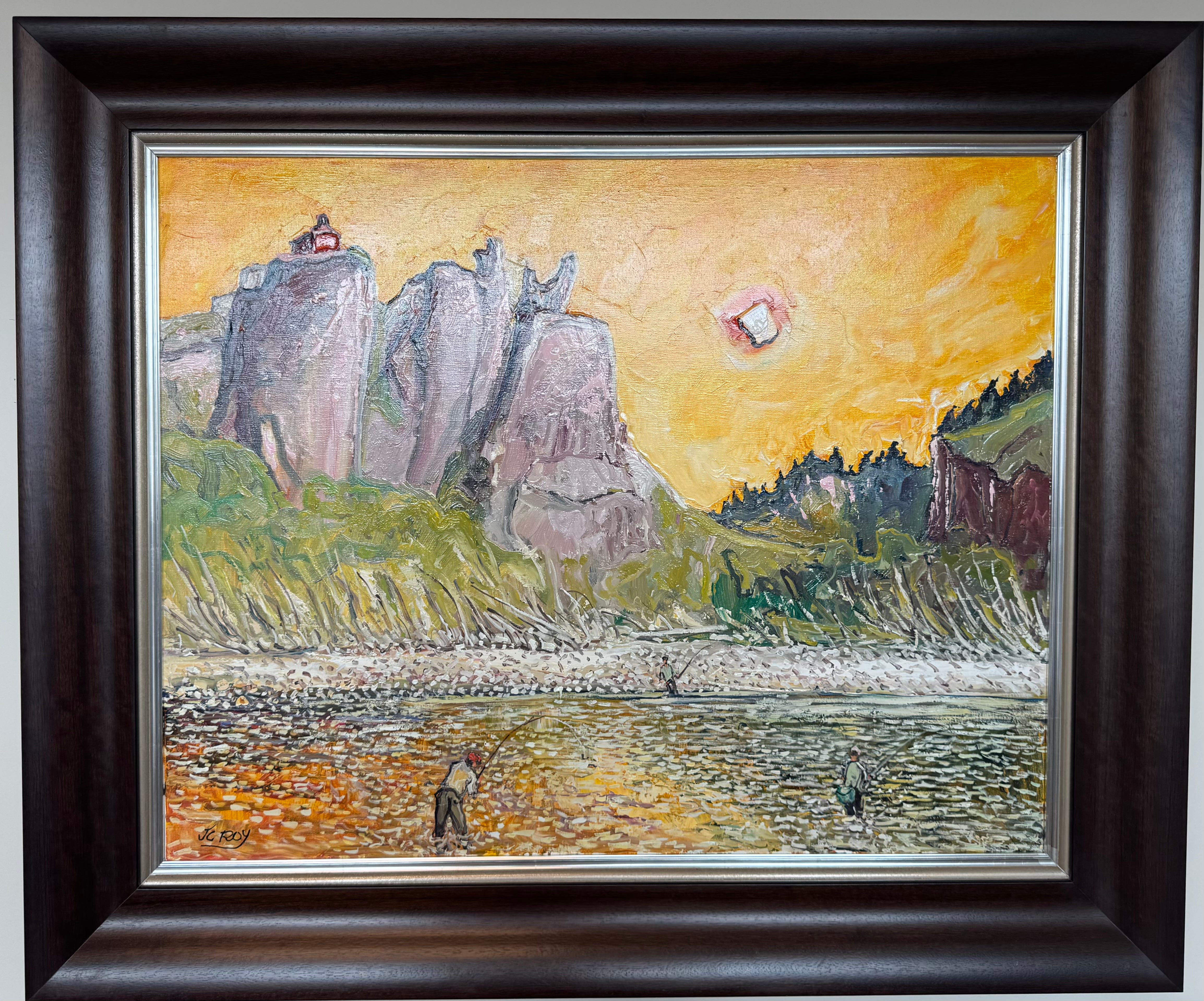
Happily, last summer I bought a painting by a French-Canadian artist, Jean Claude Roy, whom I had admired since viewing some of his pieces in the gallery at the Asheville Grand Bohemian Lodge a while back. This piece seized my attention the moment I saw it – so much yellow amidst other works with copious shades of blue, green, or perhaps red. And I spied a fisherman in the stream, wearing an orange cap. Ah ha! Love!
It has hung in my office in downtown Louisville since August, and has brightened my days since then. What better painting to try my hand at than the Roberts exercise?
My first observation: finding and then actually taking three straight hours to do this exercise proved challenging. I figured that’d be the case, so I pre-booked three hours on three separate days in late January to mid-February, assuming I could make one of them work. The first came, and other tasks intervened. The second came – same thing – other urgent tasks crowded in. The third one came and I resolved not to let it slip through. I held fast and completed the exercise last Wednesday, February 18th.

First Hour: What
I brought my chair around to face the painting. I kept my pen and journal nearby, as I wanted to record my impressions, and what I actually did, for use in this essay. My phone stayed on my desk. I started a three hour timer. Besides glancing over to the phone for a time-check four times, I did nothing with my phone during those three hours. I didn’t touch it.
Now, I am no Straussian. But I honor the artist or writer I’ve engaged with by assuming they have made the choices they have made for a reason. Maybe a good reason, maybe a poor one – but they had some definite aim in mind when choosing to craft their piece, and they made decisions in order to achieve that aim.
So in the first hour, I found myself examining What was going on in the painting. As a kid, I wanted to become a detective; I loved reading Encyclopedia Brown, the Hardy Boys and Nancy Drew. (And of course in adulthood I love Sherlock Holmes). A few years ago, I applied for a job. As part of the application process, they had me take the Kolbe A test. My results revealed that when I face a new situation, my default approach is to research it. That Kolbe A test illuminated my innate makeup more than any other test I’ve taken – Enneagram, Myers-Briggs, anything. I want to research. I want to play detective.
In that first hour, I scrutinized the painting, asking myself, What is going on in it? What have I missed before? What patterns exist?
I stood up from my chair and walked close to the painting. I viewed it from both sides. I knelt down and peered up at it. I felt my brows furrowing and my lips pursing in curiosity. I also found myself smiling at the challenge.
The first time I saw the painting, at the Grand Bohemian Lodge, I instantly seized upon the fisherman in the left foreground, in the orange cap. It took a couple moments before I saw a second fisherman, to the right. And only after I had agreed to purchase the work did I dimly observe, in the distance, barely in the water, a third fisherman.
Similarly, my pen hummed with new observations coming at me thick and fast. Here’s a sampling of those notes:
All yellow - the sky - yellow-orange
The sun is not really yellow -- white and surrounded by orange with a black V at the bottom - first noted by Amy as she was hanging the painting in my office
The water looks like a trout
The left foreground fisherman is catching a fish -- rod bent with the tension and weight of a fish on the line
In what seemed to me initially a very yellow sky - there are tinges of white - even blue beneath the sun - and orange
Gray cliffs in middle – look like a sleeping Homer Simpson
It just looks like a nice day for a fishing trip
In summary, I tried to view the painting in its entirety and its details to determine: What is going on here?
Second Hour: Why
After a short bathroom break (blessedly allowed by Roberts for this exercise, whew!) I returned and resumed my staring. I kept asking my What question, and it birthed a growing set of Why, or “What Really” questions. Again, let me share a sampling of my notes:
Much more pink in this painting than I initially saw.
What a curious place to build that red building – rocky, no trees, no shade. Why not build it on the brown ridge to the far right? Except that where it is, you can see the building clearlyThe red building on the gray clift: is that really a church or a schoolhouse?
Why does the red building sit higher in the painting than the sun?
My eyes go to the triangle formed by the red building, the sun, and the lower-left fisherman in the orange cap. What’s in that triangle? What’s in the middle of it? And what is outside that triangle?
Why did Roy paint the scene in this way?
The church/schoolhouse – sun – lower left fisherman triangle – right in the middle of that triangle is a dark space, a dark swirl. What is that dark space? A bunch of dead trees? Some odd space between the lower grass/trees and the gray cliffs? Why is that dark spot so prominent in the middle of that triangle? There is a little texture / protrusion of paint there too – it sits up from the canvas like a dark eye
The V under the sun is pointing to the fisherman by the shore. Roy wants us to see that fisherman, as I did: he wears the bright cap, he is catching a fish, he stands in bright water, the V of the sun points at him!
Don’t forget the frame. Roy matches his frames with each painting. Why did he choose this frame?
Why did Roy decide to paint this scene?
Now, I don’t know whether Roy really had reasons for these decisions or whether he made them impulsively or on the fly. But assuming he had reasons allowed me to explore the painting at a new, deeper level. It pulled back veils of meaning which enriched my engagement with and enjoyment of the work. It didn’t even matter that I came to good answers about my questions – the questions themselves brought me into a more intense relationship with the painting. Indeed, very often throughout the exercise, I could feel myself smiling, and mouthing silently the words, “I love this painting!”
Third Hour: Who
Time sped by in the first and second hours. No bathroom break needed now. I steamrolled on. I felt absorbed and wanted to continue my enriching engagement with the painting.
In the third hour, again my questioning made a subtle shift. The Why questions from the second hour evolved into Who questions: Who was in the painting? Was I in it, and if so, where? Who else was in it? Who exactly might those three fishermen be? And how did I experience the painting?
As in the first hour, I stood up. But now, rather than peering up close with pen and paper in hand to record minute observations, I backed up -- all the way to my office windows, perhaps 15’ away from the painting. New sensations and even new emotions welled up. Here are some final notes from my journal, some written during the third hour, but more upon reflection after the exercise ended:
Where are the birds? I can hear Sophie A. H. Osborn asking me: Where are the birds?
Is anyone in the school/church? Or has it been abandoned?
We see what we want to see
I want to be in the painting! I want to be one of the fishermen – we are meant to sympathize and identify with the lower left one – but I don’t really care which one I am – I simply wanted to be on the water
Which fisherman am I? I think the one closest to shore. Although I would totally wear that orange hat. Closest to shore and to the sun and to the church / schoolhouse. The most cautious, risk-averse of the three. The closest to doing something besides fishing.
I want to fish and climb the cliffs and see inside that church/schoolhouse – I am torn. Yes, I’m in the water but just barely.
If it’s a church, I want to pray inside.
Which one is Rudy [my father-in-law and fishing buddy]? Who’s the third fisherman?
The three fishermen – which is the Father, which is the Son, which is the Holy Spirit? I think – lower right is the Holy Spirit. Unless you are up close, you can’t tell he’s fishing. His rod is a thin, ghost-like line. I think the one with the orange cap is the Son – active, visible (orange), in the world. I think the one by the shore is the Father. But why do I write that?
What am I missing!?
The paint texture makes it seem like the sky has cracked, which I haven’t noticed until now, or that there are vortices swirling around the sun.
As the exercise came to an end, again a welling of feeling came up in me: I love this painting!

Reflections on the Exercise
It might be obvious at this point, but just in case, let me write it down: I thoroughly enjoyed this exercise. And it significantly enhanced my attachment to and appreciation of a piece of art I already admired and savored.
To experience myself, almost as an outside observer, delving instantly and deeply into What questions, playing detective, in a curious way reinforced the results of the Kolbe A test. When given a chunk of time, what do I do? I research. I ask: What and Why. I engage with my mind which then enhances my emotional connection.
I found it surprising that, contrary to the experience of Burkeman, Roberts and apparently most students, I instantly and deeply connected with this exercise. I did not fight myself to put down the phone. (Ah, you might fairly ask, would you have enjoyed it as much if you couldn’t have your pen and paper? A provocative question!) Not for a moment did I miss text, email or the internet. Or even the phone. Or even the instrumental or nature sounds music I often listen to while working. I felt drawn into the painting and absorbed by the exercise itself. I felt elated.
In a profound sense, I can’t convey the feelings and wonder of this exercise. Like reading The Bhagavad Gita or The Bible, or even noble literature, like Jane Eyre, you have to do it yourself.
One point of pondering has come to me since finishing this exercise. In his and Alex Tabarrok’s daily economics blog, which I read and admire, Tyler Cowen often defends social media, the internet and smartphones against their detractors. In brief, he views the content available as salutary and beneficial, at least by many people and at least potentially, and often unavailable to people any other way. My feeling is that Cowen is wrong, but let’s be clear – he’s far smarter than me, and if he and I disagree, you should probably bet on his view.
But a different tack on the issue is highlighted by technology and culture analyst Cal Newport in a recent essay, “Film Students Can No Longer Sit Through Films.” I think he latches onto something that, perhaps, Cowen has missed. It is not the content of social media and smartphones that is causing us such societal guttural pains.
It is the scrolling itself.
The very action of quickly and with the barest of intellectual attachment moving to the next thing – whatever it is, cat memes, photos of your kids, the latest non-news on Savannah Guthrie’s mom, or suffering children in another part of town or another part of the world – causes somatic shifts in our minds and bodies that we, deep down, find profoundly troubling.
Were we humans meant to scroll, taking in snippets of a rapidly passing global experience? Or to stare, with fixed attention, appreciating our corner of the world and our place in it?
I can’t answer for all humans, of course. But last week, I found the answer for myself.

(This article contains Amazon Affiliate links. As an Amazon Associate, I earn from qualifying purchases, which means that by buying from these links, you are supporting Solvitur Ambulando. Thank you!)
Burkeman, Oliver. Four Thousand Weeks: Time Management for Mortals. New York: Picador, pp. 173-177.
I loved this, Russell! So much food for thought. And yes, without even realizing I was doing so, I immediately looked for birds when I first viewed this painting! : ) One/some of the dark-green shrubs behind the grasses on the center-right side have a heron-shape, which caught my eye initially. I'd never heard of this exercise, but it sounds profoundly illuminating. Like you, I'm a researcher and would have enjoyed having my pencil and paper with me. Thank you for this wonderful essay, perspective, and idea!
Love this!