


Welcome to Solvitur Ambulando, which means “Solve It By Walking.” On this journey, we explore the alchemic potency of walking for sorting through life’s puzzles, exploring our world, and transforming ourselves. Like a good walk, you will encounter distinctive ideas, remarkable people and gorgeous scenery. I hope you will take a beautiful walk today. And if you like what you read and hear, please

As I reflect on my reading habits, over the past two years, I have read more books in community and listened to them in audiobook format than ever before. The gents books club, reading a few books with another friend or two, and slow readings with The Catherine Project, the Blue Mountain Center of Meditation, and Cams Campbell (more about which coming in Q3) has massively expanded the range of books I have read, and helped me come to more profound considerations of the books. Listening to audiobooks, usually some of the great epics and poems, reminds me that what we now consider literature used to belong to the wisdom and religious traditions of their societies. We have of course gained immeasurably through the written word. The art historian and theologian Ananda K. Coomaraswamy also once pondered what we lost through the advent of the written word. We perhaps do not perceive such a loss today, but pondering further, we might see that it was something vital indeed.
But all of life contains tradeoffs. Here are the books I said “Yes” to this quarter. Enjoy!
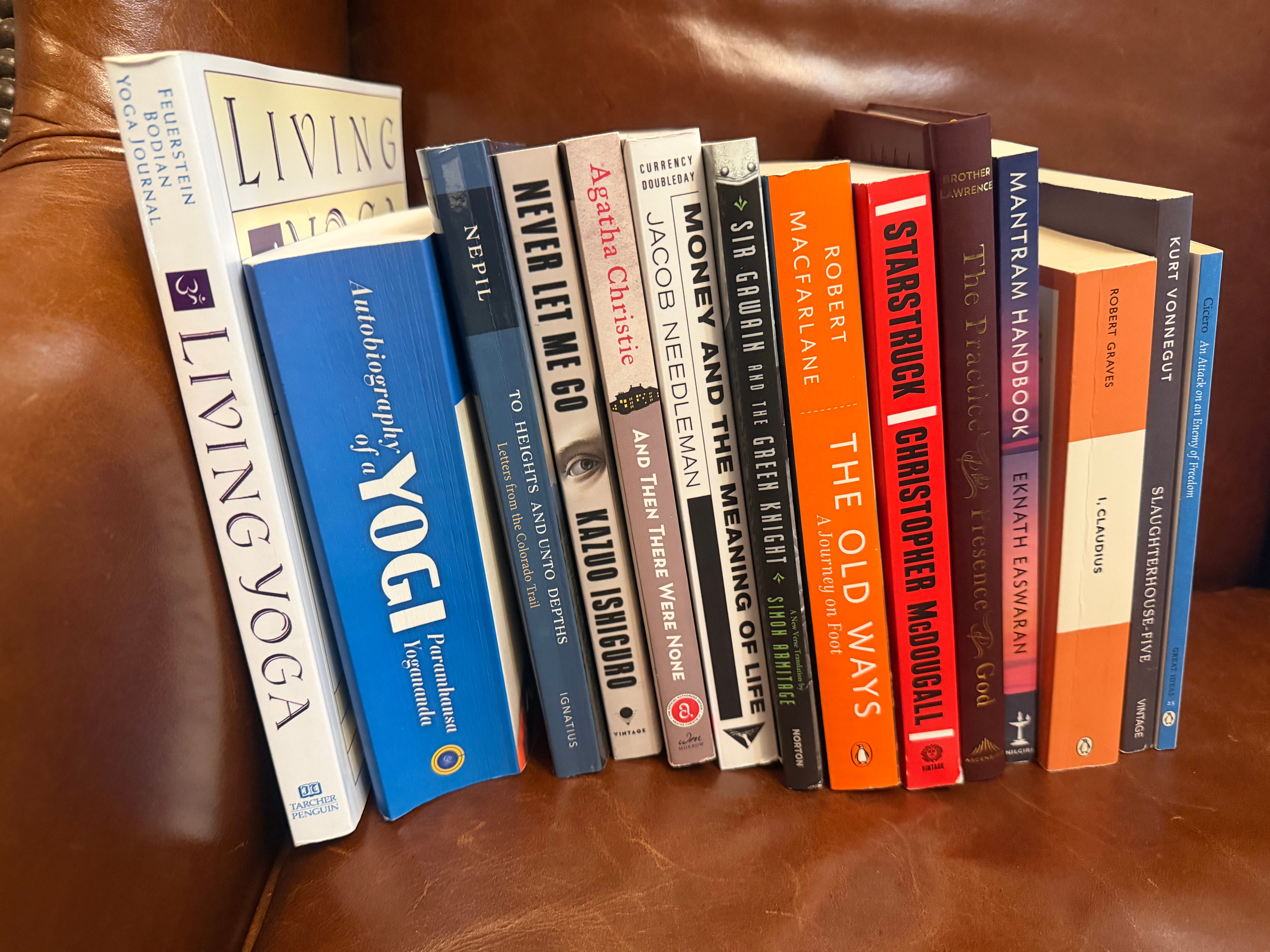
Autobiography of a Yogi by Paramhansa Yogananda
“Gravely, Mother instructed me never to use the power of words for doing harm. I have always remembered her counsel, and followed it.”
Perhaps the best known autobiography or biography of an Indian guru available in the West, my friend Alex first gave me this book 20 or more years ago. I read it then, and it made no impact on me. Then, about 10 years ago, I re-read it. While I didn’t understand it, I could tell the man had a serious and munificent aim in telling his story. This time, much more of the beauty of his story came to the fore: his seeming stumbling into his guru, Sri Yukteswar, and their instant recognition of one another; his lovely relationship with his Mother, who died young; his subtle influence on his Father over the decades; his coming to America to teach the science of Self-Realization. The only thing I looked a little askance on: toward the end, his story takes on more of the Western ethos, as he discusses how many Self-Realization Centers were opened, the great leaders installed in each new Center, and so on. Maybe he did so to augment his appeal to the hard-charging Americans. Throughout, though, he never forgets the aim of the spiritual life - union with God, and to signal the truth of existence. And how? Channeling the words and life of Jesus, he writes, “A child of God “bears witness” by his life.”
Living Yoga: A Comprehensive Guide for Daily Life edited by Georg Feuerstein and Stephan Bodian
“[T]he implication of this yogic perspective is that health, dis-ease, and personal growth are all aspects of the way in which you deal with yourself.”
“Yoga is first and foremost the discipline of conscious living. When we take charge of our lives, we also tap into our inner potential for happiness.”
Published in 1993, some of the named resources feel a bit dated. But the messages come through as urgent and timeless. I appreciated the wide array of topics examined from a yogic view: breath, stretching, peace, nutrition, and meditation, of course. But also: money, work and careers, creativity, productivity, self-respect, among others.
To Heights and Unto Depths by Fr. John Nepil
“I had climbed all the fourteeners; now my greatest joy and noblest ambition was to celebrate Mass on their every summit.”
“In the experience of beauty, man is moved to goodness; for beauty always demands an ethical response.”
“It felt as if we were going into battle.”
“I will walk among you and be your God, and you will be my people.” Leviticus 26:12
Last year, during spring break in the mountains, I read Marco Pallis’s Peaks and Lamas. This year on spring break in the mountains, I read this book, given to me by my dear friend Charles. It is always a joy to read of a man walking with his God, and reveling in the divine bliss of that walk.
Never Let Me Go by Kazuo Ishiguro (audiobook)
“From days before we went, I’d had in my mind this picture of me and Tommy standing in front of that door, working up the nerve to press the bell, then having to wait there with hearts thumping. The way it turned out, though, we got lucky and were spared that particular ordeal.”
The gents book club read this and of the dystopian novels I’ve read since last year, this one stuck in me the most. Without the flash and horror of Bradbury, Huxley or Orwell, Ishiguro conjures up a profoundly disturbing story. I don’t want to spoil it. But in it, some people are, shall we say, set aside. As someone with a congenital heart defect, this one hit home. Like those people I do have questions about my ‘wholeness.’ Am I a real, true, or maybe ‘full’ human being? Am I really? Can I live a full spiritual life? I ask these questions not to denigrate myself or anyone with any health challenge, but because people have asked those questions for centuries, at least, and they do not answer with any sort of universal voice. Never Let Me Go raised those questions for me again. Deeply evocative and haunting, the book club enjoyed a spirited conversation.
Money and the Meaning of Life by Jacob Needleman
“The aim is nothing more nor less than to sacralize the money question. This does not mean making money itself sacred. It means finding the precise place of money at the heart of the most important undertaking of our lives – the search to become what we are meant to be, in service of that greatness that calls to every man or woman on this endangered earth.”
“[T]he perennial question of humanity, the only question worth devoting one’s life to, is: how are we, how am I, to live fully in the world of “birth and death,” the world of organic life on earth, the world of society, responsibility, making and doing - while at the same time fulfilling the immensely higher and greater possibility that is offered to us as human beings?”
Needleman edited a book I read last year, The Sword of Gnosis, a compilation of Traditionalist writers like Marco Pallis, Rene Guenon, Frithjof Schuon, among others. He also contributed to Living Yoga. It intrigued me, so I ordered the book. At the same time, I listened to my friend L. Vago’s interview with money mapper Daemonic, and signed up for a session. Following, well, a lot of what has happened in life across the past 10 years, I found it a worthwhile exercise to delve into my view of the meaning of money in my life – not society’s opinion or others’s views, but my own. This book – and the discussion with Daemonic – aided that reflection immensely.
And Then There Were None by Agatha Christie
“Ladies and gentlemen! Silence please! You are charged with the following indictments”
If I learned anything this year, I learned two things. First, they ain’t lying about the Tower of Pisa leaning. Second, they ain't burying the lede with the title of this book.
Sir Gawain and the Green Knight translated by Simon Armitage (audiobook)
“Then the warrior in green mocked Gawain again:
“‘Now you’ve plucked up your courage, I’ll dispatch you properly.
“‘May the honorable knighthood heaped on you by Arthur –
“‘if it proves to be powerful - protect your neck.’”
As I have learned with The Iliad and The Odyssey, I am coming to enjoy listening to the old epics and poems more than reading them. Such was true for this tale too. Armitage’s translations might disturb some academics. Not literal, he attempts to make the story flow as he conceives the original to move, using modern language, idioms and metaphors. Personally, I like it. Especially as an audiobook, the story comes alive, and if I ever want to investigate a more academic rendering, I can do so.
The Old Ways by Robert Macfarlane (audiobook)
“It was a pilgrimage of a very different kind. Rick was accompanying Jonathan Wright’s daughter, Asia - who had been a baby at the time of her father’s death -back to the place where he had died. She wanted to understand why her father had risked his life and eventually died for these mountains, and Rick wanted to help her with that, so she came here on foot.
“‘They had a hell of a time even getting close to the mountain. The weather conditions were terrible – blizzard, lightning, thunder – but at last they reached the monastery, and from there Rick and Asia made it up onto the glacier. And eventually Rick guided Asia to the point where he remembered burying her father.
“‘To their horror and fascination, Rick found the cairn but he also discovered a flap of Gore-tex showing beneath the stones. He understood straight away what had happened. The glacier had shifted, and the cairn had shifted with it, but - in the surprisingly tender way of glaciers – Jonathan’s frozen body had been pushed to the surface.’”
“Jon paused. ‘Rick told Asia to wait at a distance, and he made her confirm that she wanted to see her father. She did, and so she approached, and there her father was, not returned from the grave but returned by it. She was able to see him in the flesh, preserved almost as well as the day he died. She could touch his face, and she did so. She cut a lock of his hair. Shortly afterwards, they reburied Jonathan, twenty years on from his death.’”
Subtitled “A Journey on Foot,” Macfarlane also takes to water and ice seeking the well-worn paths of our ancestors. I enjoy Macfarlane’s writings, at times marveling at his turn of phrase and imagery. But I own five of his books; this is the second I read. And those two I started and stopped several times before I completed them. Here, I fear I must confess the suspected reason – I feel jealousy and envy of Macfarlane. I know I will never explore, or walk, or write as generously and lovingly anything as he has about so many things.
Starstruck: A Journalist’s Pursuit of a Fugitive Pop Star, Her Diabolical Maestro, and Their Teenage Sex Cult by Christopher McDougall
“To me, the warden gave a weary smile. He switched back to English. “Enjoy your visit,” he said. “Miss Trevi is very –” He paused, reflecting. “You’ll see.””
McDougall’s Natural Born Heroes remains one of my favorite books, 15 years after its publication. I loved Born to Run, even though I hate running. I even loved Running With Sherman, his story of human-donkey racing, because, well, why not?
McDougall’s herky-jerky style fits this latest book especially well. Famed Mexican pop superstar Gloria Trevi, and her manager/lover/seducer Sergio Andrade ran a teenage sex cult for years, and spent years on the lam with them. But about halfway through this fascinating tale, I couldn’t stomach it anymore. Even if I didn’t have teenage daughters, I doubt I could have continued. I put down the book, blaming all the adults – Andrade, Trevi, other singers, the girls’s parents – maybe especially them. They wanted superstardom so badly for their daughters – but, perhaps, most of all, for themselves – that they damned their daughters to drugs, abuse, and pure evil. Let the damn dream go lest you awaken to a nightmare.
The Practice of the Presence of God by Brother Lawrence
“[M]y kitchen duties. This kind of work was my greatest natural aversion. But, having grown accustomed to doing everything there for the love of God, and in every circumstance asking Him for grace to carry out my work, I found my fifteen years of work in the kitchen to be very easy....I found joy in all places by doing little things for the love of God.”
I read this book along with a couple friends. Let’s just say that I could use a little more of Lawrence’s outlook in my life. It reminds me of the lines from The Bhagavad Gita:
“A leaf, a flower, a fruit
Or even water, offered to me in devotion,
I will accept as the loving gift of a dedicated heart.
Whatever you do, make it an offering to me.
The food you eat or worship you perform,
The help you give, even your suffering…”
Like I said, I need more of this posture, this attitude, this behavior, in my life.
Slaughterhouse Five by Kurt Vonnegut
“There was a soft drink bottle on the windowsill. Its label boasted that it contained no nourishment whatsoever.”
We read this for the gents book club. I hated the first half of the book. Well, hate may not quite be right. I didn’t understand the point. But the second half, well, I didn’t follow it as well, but the point came through loud and clear. Vonnegut subtitled the book, “The Children’s Crusade,” a phrase curiously used by Hermann Hesse in The Journey to the East. I’ve tried to investigate their influence on or thoughts about each other. “The Children’s Crusade” may have only been a strange coincidence. As best as I can tell, Vonnegut didn’t think much of Hesse, and I have found no evidence that Hesse knew of or read Vonnegut. It’s all too bad, because both essentially tackled the same quandary – what do we do now that we’ve made a mess of everything?
An Attack on an Enemy of Freedom by Cicero
“People who say Caesar was enviable are profoundly misguided. For no one can be said to have a happy life when its violent termination brings his slayers not merely impunity but the height of glory.”
In preparation for our trip to Italy, I wanted to read a little Cicero. Despite his, to be generous, vainglorious nature and cowardice, I like him the best of the Roman writers and orators. He best combined contemplation and action. He also knew that freedom requires many things to survive. He offered his voice, one requirement, and he does not deserve blame that his contemporaries could not supply the other needed virtues.
12. I, Claudius by Robert Graves
“My tutor...Marcus Portius Cato...was always boasting of his ancestors, as stupid people do who are aware that they have done nothing themselves to boast about.”
The Dhammapada contains a verse:
“He who controls rising anger, like a rolling chariot, is a real charioteer. Others merely hold the reins.”
Now, for some reason, every time I read that verse, or it came to mind, I thought of I, Claudius. Why? No clue. But this went on for a couple years. So, I took our trip to Italy as the occasion to finally check out what my subconscious or something was urging me to read. I don’t read much historical fiction but I loved this story. Fast-paced, intricate, conniving, horrifying. You almost get the sense the Roman Empire was pretty good for most people – except the royal family.
Strange News from Another Planet by Hermann Hesse
“Ziegler did everything that such people always do and was just like them. He was not untalented, but also not talented. He loved money and entertainment, liked to wear nice clothes, and was just as cowardly as most people. His life and actions were determined less by impulses and aspirations than by prohibitions and the fear of punishment. At the same time he had many honorable qualities and was in general, all things considered, a delightfully normal man who thought of himself as very nice and important. Indeed, he regarded himself, just as every person tends to do, as a unique individual, while he was really typical. He believed that his life and destiny were at the center of the world’s attention, just as everyone does. He had very few doubts, and when the facts contradicted his views on life, he shut his eyes in disapproval.”
In Florence, we wandered into a lovely bookstore, La Feltrinelli, which had a generous English-language section. I’d never heard of the Penguin Archive and so picked up a few. I enjoy small editions of books, and often travel with a few of the small Penguin series (Great Journeys, Great Ideas, Little Black Classics, and others) or Mouse Book Club (alas, defunct) ones. A serendipitous collection. I enjoyed “A Man by the Name of Ziegler” and “Augustus” especially. I’ve come to see Hesse as perhaps the great soft teacher in my life. He does not beat you over the head with his language or his plot. He gently nudges, at most, knowing that, probably, you and I need to come into wisdom gradually, over long periods of time and after much reflection on our inner and outer lives. I need such nudges and am glad to have had Hesse slowly, patiently teaching me for over three decades.
The Mantram Handbook by Eknath Easwaran
“Deep within us we have immense reserves of will, loyalty, patience, compassion, and love; it is only that we do not know how to unlock these resources and bring them into full play in our daily lives. But this is something all of us can learn to do if we can gain control of our minds.”
I read this alongside Easwaran’s Blue Mountain Center of Meditation slow reading group. We read only four to 10 pages per week. Generally, I read the section when it was announced on Saturdays. Then I often re-read it several times throughout the week. A good way for me, who tends to read quickly, to force reflection and serious attempts at integration into life.
Coomaraswamy: His Life and Work by Roger Lipsey
“When they faced the modern world, Coomaraswamy and [Rene] Guenon opposed it, but when they devoted themselves to study of traditional ideas and symbols, they were at peace: they were like desert cacti, thorny and hostile on the outside, sweet on the inside. In Coomaraswamy’s notes, a fragment expresses this sweetness in few words: “the point of view which I recommend ‘searching the scriptures’ is that of Chandogya Upanisad VII.26.2: ‘from taking hold of the traditional-teachings there is release from all the knots (of the heart).’” If they were warriors, it was not to introduce new conflicts but to remind their readers of categories of experience that are beyond conflict.”
“In his later years, Coomaraswamy was trying to free himself from his biography.”
“Blessed is the man on whose tomb can be written, Hic jacet nemo.”
Ananda K. Coomaraswamy, one of the 20th century’s greatest proponents of Traditionalism or The Perennial Philosophy, wrote little about himself in all his voluminous articles, books, sketches, monographs and reviews. Lipsey performed yeoman’s work, digging through his writings, letters, family memorabilia and even postcards, interviewing his son Rama, Coomaraswamy’s last wife Dona Luisa and colleagues and friends, to reconstruct this life. Lipsey gives a measure of the man and his gigantic intellectual stature, while also offering useful critiques of his life and limitations of his ideas. I’ve come to admire Coomaraswamy immensely. This book humanizes, without diminishing, the wonderful man. It intrigues me, as it did Lipsey, to understand Coomaraswamy in the period 1928 to 1932, when he mysteriously turned his attention from art and symbols to metaphysics, mysticism and the source scriptures of the great Traditions of human history. Lipsey acknowledges we find only a few breadcrumbs of this dramatic transition – we see the evidence of it, not why it occurred. We likely never will. Maybe some people simply sense they must evolve, and they perform their own evolution on themselves. Maybe it was a kind of grace. At least, those are the two best explanations I can conjure up for Coomaraswamy’s remarkable shift.
Also, Coomaraswamy was a fly fisherman. I loved learning that factoid.
The Death of King Arthur translated by Simon Armitage (audiobook)
“Our king kept on hunting with a heavy heart….And good Sir Gawain in his glinting gear, face down in the field, fists full of grass, his bold, red banners brought to the floor, his sword and broad shield swimming with blood. Never was our sovereign so saddened and sorrowful, or so sunk in his spirits as he was at that sight. The sovereign stared, stricken with horror.”
I enjoyed Armitage’s translation of Sir Gawain and the Green Knight so much, I listened to this one too. I felt surprised that I reacted so, well, mournfully, to the deaths of fictional characters who, had they lived, performed deeds I would charitably describe as horrific. And yet I did, indeed, mourn the passing of “good Sir Gawain” and Arthur, “our once and future king.”
What a terrific quarter! Onward to Q3…to Shakespeare, poetry, Sri Ramakrishna and more!

(This article contains Amazon Affiliate links. As an Amazon Associate, I earn from qualifying purchases, which means that by buying from these links, you are supporting Solvitur Ambulando. Thank you!)
Dont you love that books and experiences often appear together in life serendipitously?